
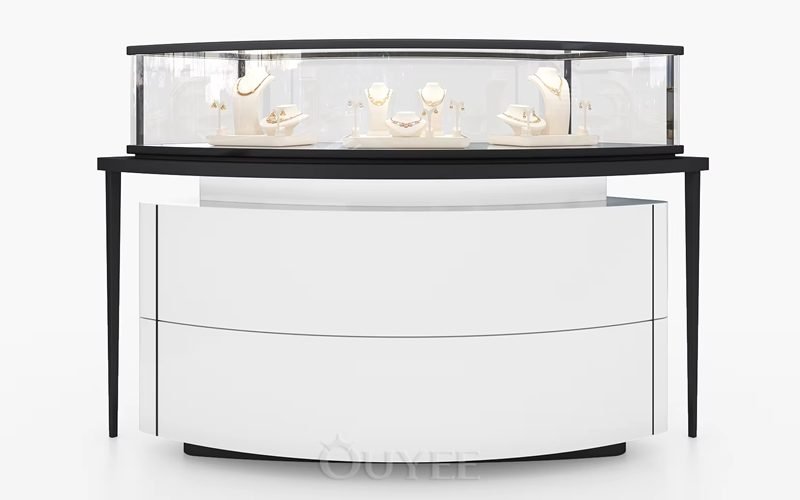
Smoke shop showcase key management starts with a stable identity for every cabinet, every independently locked compartment, and every issued key. Give each fixture a simple reference, map each opening to its verified key, and record who receives and returns each copy. Test that map against the delivered cabinets before opening the store. A row of similar glass cases can look interchangeable while having different locks, so appearance alone is an unreliable guide.
This guide covers furniture identification and staff handover in a lawful retail business. It does not establish a burglary resistance rating, approve a lock specification, or describe rules for storing regulated goods. Confirm those separate requirements with the responsible local professionals. For the broader furniture decision, start with our guide to smoke shop fixtures and lockable cases; the task here is making the selected cabinets manageable after delivery.
Separate the cabinet, opening, and key identities
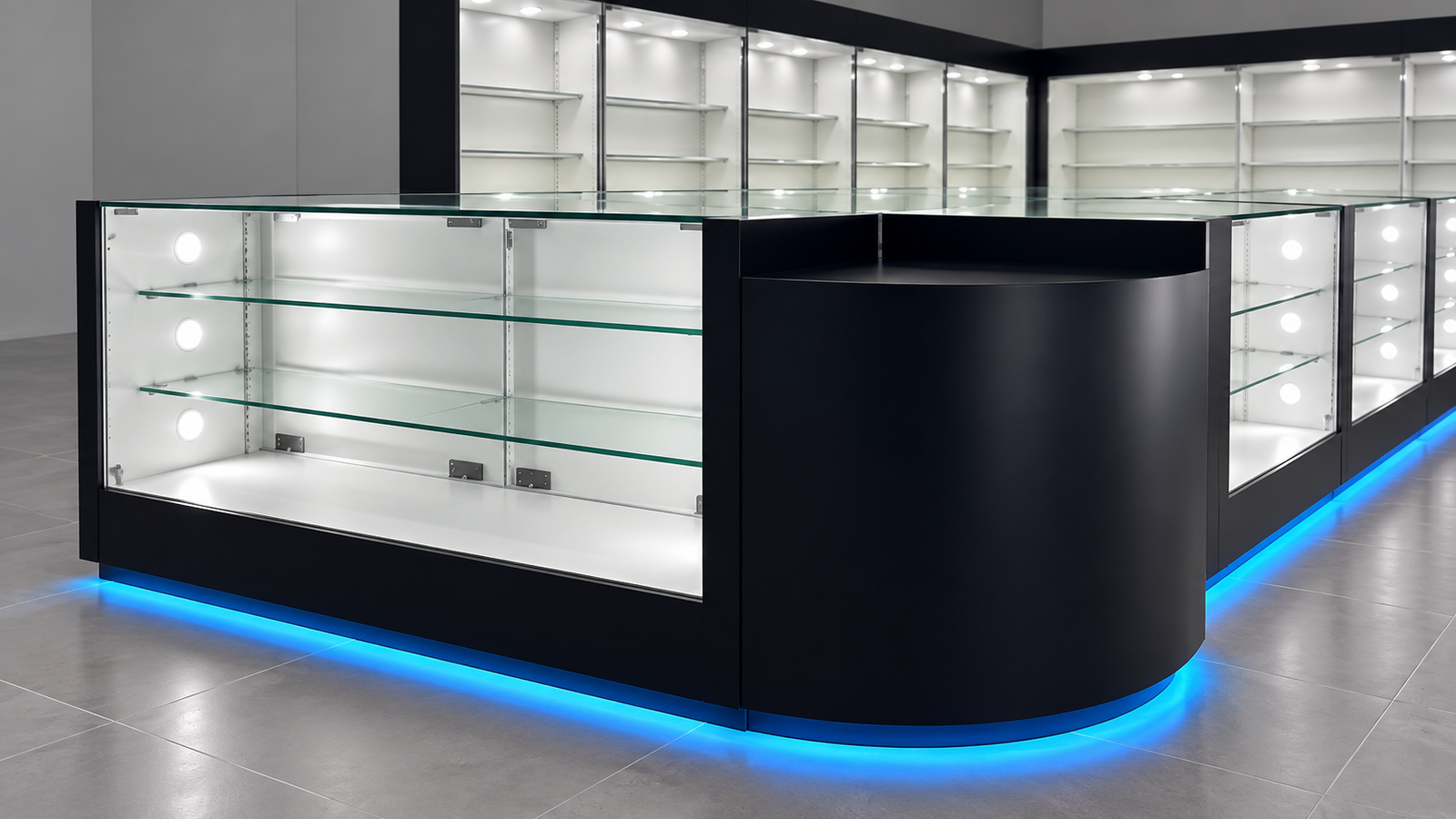
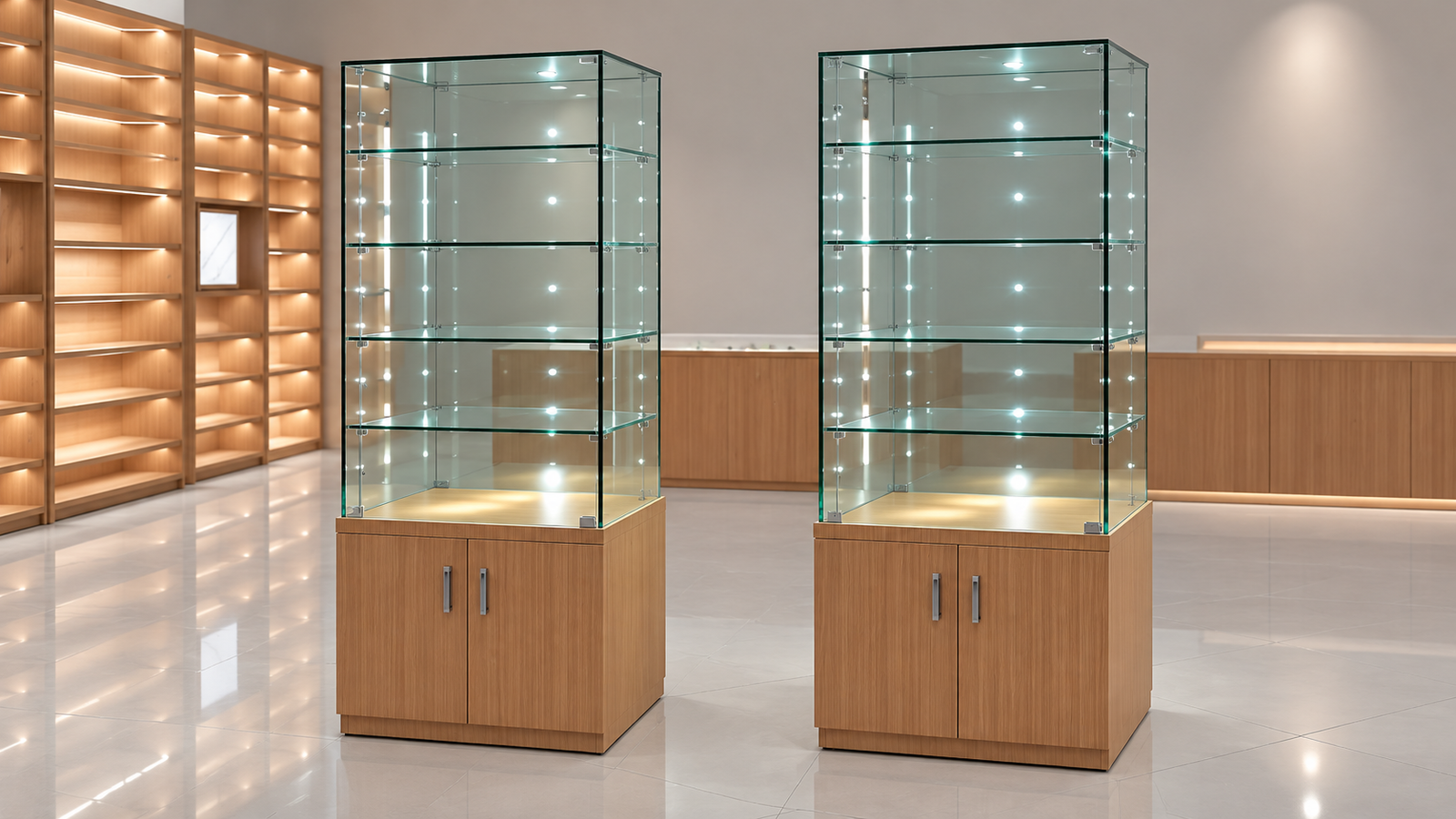
A cabinet number tells staff which physical fixture they mean. An opening number identifies a particular door, sliding panel, or lower storage compartment. A key reference identifies the authorized key or key group. Keeping these three identities separate avoids a common problem: a case may contain several openings that do not share the same key.
For example, an internal register might identify a fixture as C-04 and its display opening as C-04-D1. Its working key could have the internal reference K-12, with separately recorded copies. These are illustrative identifiers, not manufacturer lock codes. Use a naming system that your team can explain without guessing, and keep the relationship between identifiers in a restricted register.
Do not automatically number a cabinet by its current position in a merchandising sequence. A fixture called “third from the entrance” becomes ambiguous when the store layout changes. Retain the asset reference when the fixture moves, then update its location in the register. If an opening is replaced or removed, retire its old entry rather than silently reusing it for different hardware.
Confirm the supplied key arrangement before ordering labels
Ask the cabinet supplier for a written opening schedule tied to the approved furniture drawing. It should distinguish display access from lower storage and identify the intended key grouping. Establish whether keys are unique to each opening, shared across an agreed group, or part of another documented arrangement. Do not infer a master-key capability from a photograph or from two keys that look alike.
A shared key can reduce the number carried during service, but it can also broaden the access associated with a missing copy. Separate keys can support more limited access, but they require a clearer issue process. Select the arrangement according to the business’s authorized access policy and the actual hardware offered. A label cannot compensate for an unsuitable keying decision.
For smoke shop furniture planning, include the requested schedule in the quotation and handover documents. Ask who confirms it at the factory, who checks it on arrival, and how discrepancies are resolved. Request the supplier’s instructions for replacement keys and compatible replacement locks without publishing those details on public cabinet labels.
Build a working register with useful evidence
A useful register connects the physical cabinet to a current access decision. It should be possible to find a fixture, identify its opening, locate the relevant issued key record, and contact the responsible person. Record only information that supports those tasks. Avoid turning a public floor plan into a detailed guide to where keys are stored.
| Record | What to enter | How to verify it |
|---|---|---|
| Fixture identity | Stable asset reference and current location | Match the installed fixture to the approved layout and its discreet identifier |
| Opening identity | Door or compartment reference and access side | Inspect the actual opening with an authorized staff member |
| Key relationship | Internal key reference and confirmed grouping | Check the supplied key against the intended opening under supervision |
| Copy accountability | Separate copy references, holders, and spare status | Count the physical copies against issue and return records |
| Handover | Issuer, recipient, time, return, and unresolved exception | Obtain acknowledgment when custody changes |
| Change history | Replacement date, affected openings, and approver | Recheck the current arrangement after approved work |
Universities offer useful examples of accountability principles, although their campus procedures are not retail requirements. University of Waterloo’s key control guidance describes authorized departmental contacts, returns, and reporting lost or damaged keys. The transferable idea is to define responsibility clearly; use your own business’s approval and reporting process.
Choose discreet labels and a restricted map
Put the fixture identity where authorized staff can read it during normal work without obstructing the product view or access hardware. Confirm the label location and adhesive with the furniture supplier so the finish and cleaning instructions are respected. A removable internal label may be appropriate for some surfaces; permanent engraving or drilling requires separate approval.
Test the label in the lighting and viewing conditions where staff actually work. Tiny characters, reflective finishes, and confusing letter-number combinations can defeat an otherwise sensible system. Write identifiers consistently in the register and on handover records. Color can help staff recognize groups, but retain readable characters so the system does not depend on color alone.
Use an internal reference on a key tag rather than a description that advertises exactly what valuable contents it opens. Keep the detailed map available only to authorized people. Do not publish close photographs of keys or manufacturer key codes in a public staff guide, sales document, or social post. The public-facing cabinet number and the restricted key relationship serve different purposes.
Check the delivered cabinets and supplied copies
Carry out the mapping exercise before the cabinets enter ordinary service. Use the actual supplied hardware and every delivered copy, with the responsible person present. Check the expected opening under the supplier’s operating instructions, confirm normal closure, and record the result. Stop if a key binds, a door does not align, or the delivered arrangement differs from the schedule.
Do not force a key or improvise an adjustment to make an incorrect entry appear correct. Mark the affected opening as unresolved and refer it to the supplier or authorized locksmith. Record whether it can be used safely under the business’s interim procedure. A cabinet that looks complete may still need an access discrepancy resolved before acceptance.
Inspect the working space as part of the same handover. Staff must be able to reach and operate the intended opening without moving another fixture or leaving a key where a customer can take it. Our retail fixture site survey guide explains why final installed conditions deserve a separate check. It does not replace the supplier’s lock and door instructions.
Make staff handover a custody change
A handover should establish who has each issued copy now, rather than simply recording that a bunch of keys was present earlier. The outgoing holder and incoming holder should compare the identified copies with the current record. Note any missing, damaged, or unexpected key before closing the handover. Assign a person to resolve each exception.
Decide where working keys are held during service and where approved spare copies are kept. Those locations should follow the store’s access policy and remain outside public reach. Do not leave a working key in an unattended showcase or attach every copy to a single uncontrolled ring. A spare remains part of the inventory even when it is rarely used.
Set a process for staff transfers and departures. Collect the physical copy, record the return, and reconcile it with the holder’s outstanding entries. If a return cannot be confirmed, treat it as an exception requiring a management decision. Avoid erasing the old entry simply because the employee no longer appears on the current schedule.
Handle missing keys and cabinet changes without losing the record
When a copy is missing, record which copy is affected, its last confirmed holder, the time it was last accounted for, and the openings associated with it. Notify the designated manager promptly under the business’s procedure. That person should assess access exposure and arrange professional advice where needed. Finding another copy does not resolve the missing one’s whereabouts.
Kwantlen Polytechnic University’s key control practice emphasizes records of keys issued, returned, and held by individuals. Campus-specific ordering and access procedures should not be copied into a retail procedure. Keep the register current and let the authorized decision maker determine the response to an unresolved loss.
After an approved lock replacement, update the affected opening and key relationship together. Recheck the supplied copies, record who approved the change, and retire obsolete entries. If a cabinet moves, update its location while retaining its stable identity. If several units are exchanged, verify their identities individually rather than assuming the old drawing still describes the installation.
Use a short audit to keep the map accurate
Choose a review frequency appropriate to your business and add a check after a layout change, key loss, or hardware replacement. Compare physical copies, current holders, spare copies, and the live register. Investigate differences instead of adjusting the count to match a preferred total. Record the reviewer, date, exceptions, and resolution.
Before accepting new glass showcase furniture, confirm that the operating instructions and approved key schedule will accompany delivery. For comparable cabinet formats and access questions, our specialty retail cabinet guide provides broader selection context. Keep those buying decisions separate from the ongoing responsibility for issued copies.
Further learning: key custody in a service environment
Amity University Jaipur’s lecture below discusses lost-and-found and key control in the hotel industry. Its service setting differs from retail, but the key custody discussion offers useful background for training staff to account for issued keys and escalate losses. Apply your own store procedure; the lecture does not specify showcase hardware, certify security performance, or establish local retail obligations.
Watch the Amity University Jaipur lecture on YouTube.
Frequently asked questions
Should every showcase have a different key?
There is no universal arrangement for every store. Confirm the available hardware, authorized access needs, and consequences of a missing copy before choosing separate or shared key groups. Record the arrangement and verify it on the delivered cabinets.
Is a cabinet number the same as a key number?
No. The cabinet reference identifies the fixture, while the key reference identifies an access item or group. One cabinet may have several openings, and an agreed key group may serve several openings. Keep the mapping in a restricted register.
Can labels prove that a showcase is secure?
No. Labels support identification and accountability. They do not establish a lock’s resistance rating, glass performance, or a complete security system. Any claimed performance needs separate evidence for the supplied product and installation.
What should staff do if a key no longer operates normally?
Stop forcing it, identify the affected cabinet and opening, and report the issue to the responsible person. Follow the supplier’s instructions and use an authorized service provider for inspection or replacement. Record any change to the key relationship.
When should the key register be updated?
Update it whenever a copy is issued, returned, lost, replaced, or retired, and whenever cabinet location or hardware changes. Periodic physical checks help reveal differences between the record and the keys actually held by staff.












 English
 German
 Arabic
 French
 Spanish
 Italian
 Russian
 Turkish
 Portuguese
 Japanese