
The main types of perfume kiosk display fixtures for mall fragrance retailers are tester counters, glass merchandise cases, compact display towers, illuminated brand panels, and enclosed stock cabinets. Choose their combination around the approved mall footprint, the way customers sample scents, and how staff retrieve sealed bottles. A useful kiosk gives each task a defined place without spreading queues or opened drawers into the public route. This guide compares fixture roles and shows what to check before asking for a quote. It focuses on a freestanding mall kiosk; a full perfume shop needs a different perimeter and backwall plan.
Start with the leased footprint and the selling sequence
Ask the mall for a dimensioned lease plan before selecting a counter shape. Record the boundary, columns, floor connections, permitted signage zones, and the side from which staff enter. A rendering can make a kiosk look spacious while leaving no practical place to stand with a cabinet open. Draw the fixture, the working person, and the customer as separate occupied areas. Include the delivery route and the largest crate or module that must reach the pitch.
Then describe a normal sale: a customer notices the range, asks about a fragrance, tries a sample, selects a sealed bottle, pays, and leaves. Give each step a surface or storage location. Place frequently requested stock within a manageable staff route, and keep packaging away from the tester area. For a wider store project, use the perfume retail display buyer’s guide to plan backwalls and room-based merchandising. Here, the priority is fitting those jobs into a small island.
Compare the five fixture roles
| Fixture type | Main task | What to specify | Common mismatch |
|---|---|---|---|
| Tester counter | Supported sampling and staff conversation | Wipeable top, removable tester tray, used-strip collection, clear service position | Too many bottles leave no working surface |
| Glass merchandise case | Visible presentation with staff-controlled access | Actual pack fit, lock access, glazing details, replacement access | Doors collide with a staff aisle or adjacent unit |
| Display tower | Visible assortment on several approach sides | Stability details, shelf adjustment, manageable stock reach, protected corners | Height blocks sightlines and hides the selling position |
| Brand panel or lightbox | Recognizable kiosk identity | Mall-approved position, replaceable graphics, electrical access | Marketing graphics exceed the permitted envelope |
| Stock and packing cabinet | Organized sealed bottles, bags, and packaging | Inventory zones, shelf load documentation, lock schedule, usable opening space | Display capacity is quoted but stock capacity is ignored |
These are functional comparisons, not standard dimensions or product ratings. A small kiosk can combine several roles in one module, but the supplier should identify the tradeoff. A tower with storage below may be useful; it still needs a safe restocking position. A glass counter can carry testers on top; it still needs a separate, clean sampling tray and room for payment equipment.
Tester counters: keep the sampling process deliberate
A tester counter should support a conversation, rather than become a crowded bottle shelf. Lay out the actual tester assortment with blotter strips, a waste container, and a place for the customer to put a bag while speaking to staff. Use a removable tray so the team can clean around bottles and reset the range. Do not assume a glossy finish will tolerate repeated contact with the products or the chosen cleaner: request a sample and carry out a realistic compatibility check.
Decide whether customers may handle every tester or whether staff assist. That choice changes the position of the tray, supervision, and refill storage. Keep labels readable and avoid using decorative bottles in place of the stock that shoppers will receive. If a retailer also offers filling or decanting, treat it as a separate operation to review with the mall and relevant authorities. A normal display-counter quote does not establish permission for on-site filling, bulk storage, or any particular hygiene procedure.
Cases and towers: balance visibility with retrieval
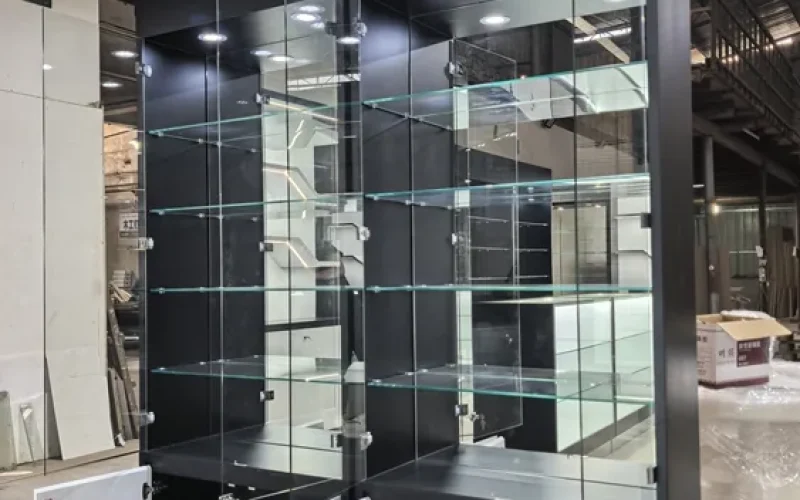
A glass case makes packaged stock visible while allowing staff to control access. Test the cabinet with the largest carton, gift set, and promotional sleeve in the planned range. Check the real opening, not only the overall case depth. Ask how staff remove a product from the back row without disturbing the front row, and where a removed shelf can be placed during a range reset.
Display towers make an island noticeable from multiple directions. Their value depends on a stable installation and useful viewing angles. Ask for the base and fixing details approved for the leased site, and verify that maintenance does not require moving a fully stocked tower. An illuminated shelf can make an empty fixture look dramatic but may obscure labels once bottles are added. Request photographs or a sample bay with representative packs and inspect it from normal customer positions.
Choose a counter arrangement that fits the staff route
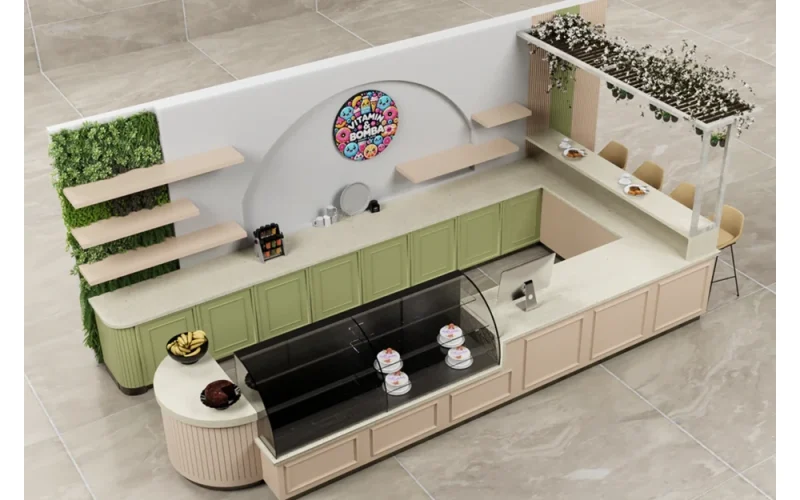
A straight counter is easy to understand but needs a clearly defined staff side. An L-shaped arrangement can separate sampling and payment while concentrating storage at a corner. A U-shaped island may provide several display faces, but the opening must remain usable when staff are carrying stock. More display perimeter does not automatically mean a better kiosk: a shape that forces staff to turn through a tight opening can slow even a simple transaction.
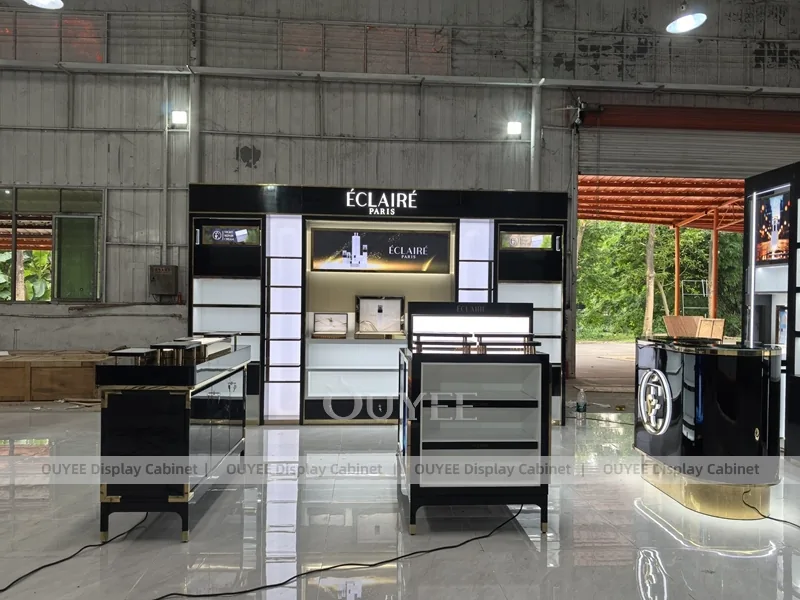
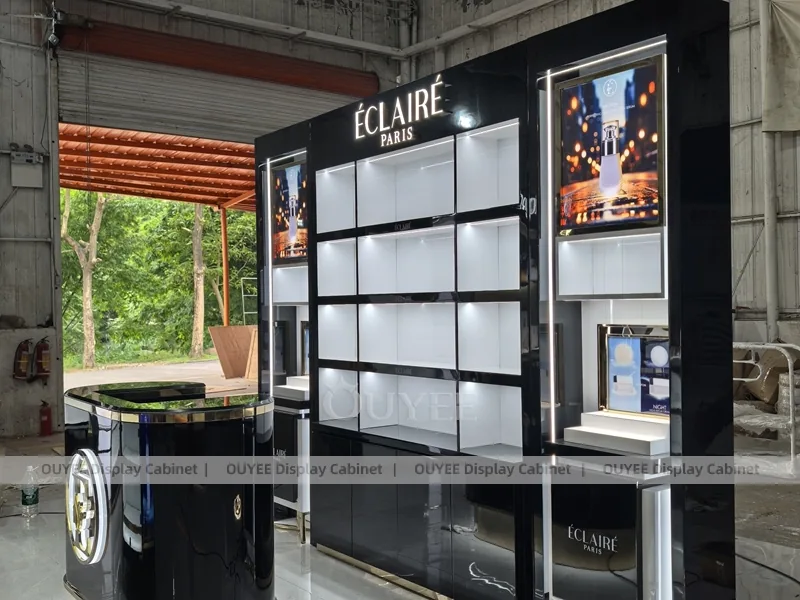
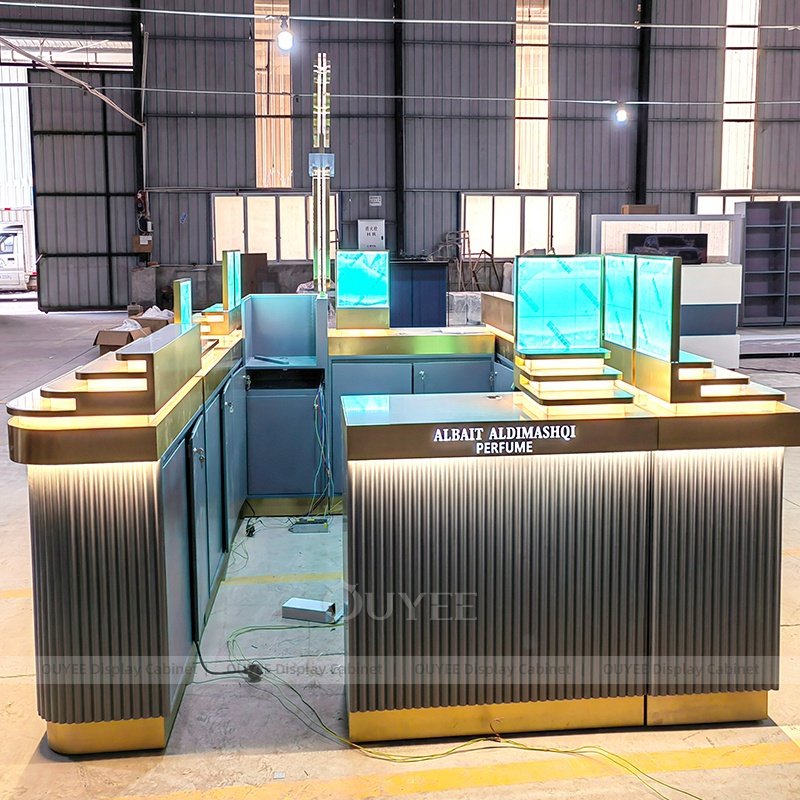
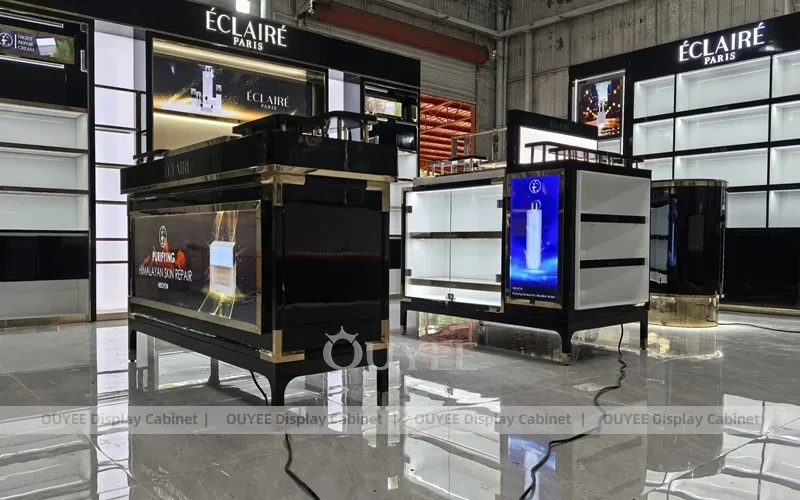
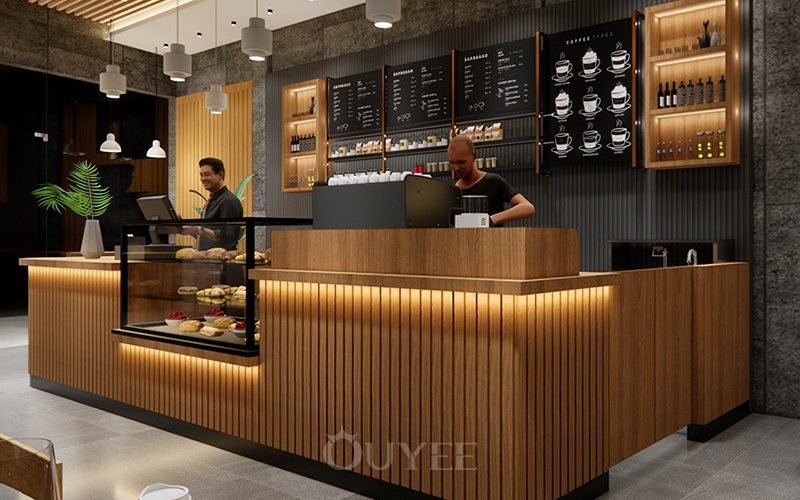
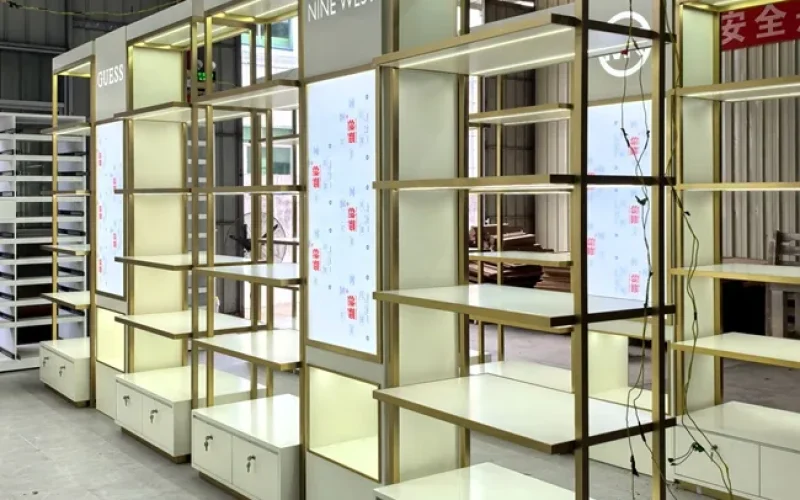
For examples of actual construction, compare the black perfume promotion kiosk with a display tower and the gold and gray perfume kiosk. Their photographs show different visual and counter arrangements; they do not establish a standard footprint, certified load, or approval for your mall. Ask for project drawings based on your own site survey and product assortment.
Plan the accessible service position and public approach
Set aside an accessible place for the transaction from the beginning. Do not use a temporary stool, promotional rack, or stock carton to occupy the intended customer approach. Review the U.S. Access Board’s ADA resources and the 2010 ADA Standards with the designer responsible for the project. These sources support the accessibility review; they do not certify a photographed fixture or replace local review.
The education video below explains sales and service counters. Use it to understand why the counter surface and the customer’s approach must work together. Have the responsible designer apply the requirements to the final drawings, including surrounding circulation and the services actually offered. The leased outline alone does not show whether a queue, open door, or protruding sign will obstruct a route.
Specify lighting, power, and access for maintenance
Show each powered component on the drawing: shelf lighting, brand lightbox, point-of-sale equipment, and any screen. Ask where cables run, where drivers or power supplies sit, and how a failed part is replaced. Keep the distinction between fixture supply and site electrical work clear in the quote. A photograph with glowing shelves is not evidence that the installation meets the site’s electrical requirements.
Inspect lighting with filled shelves, reflective glass, and actual packaging. A bright hotspot can obscure text or make glass glare unpleasant. Check whether a graphic can be changed without removing merchandise, and whether access panels are reachable after neighboring modules are installed. Ask for component specifications and replacement arrangements. If a screen is included, identify who supplies the player, network connection, content, and ongoing support before accepting a bundled price.
Write a quote brief that suppliers can price consistently
Send the approved footprint, product dimensions, assortment list, desired fixture roles, stock volumes, and photographs of the surrounding mall finishes. Separate required items from optional ideas. Ask for quantities, materials, finish samples, glazing descriptions, locks, lighting scope, packaging, assembly work, and delivery assumptions. Identify whether the price covers one kiosk or a repeatable roll-out design.
Compare equivalent scopes. One supplier may include graphics and internal lighting while another prices only the cabinets. Check drawing revisions, sample approval, spare parts, shipping terms, and responsibilities for on-site adjustment. The perfume display planning resources can help organize the brief, while perfume shop design examples are useful for visual direction. Keep those inspiration references separate from the dimensions and acceptance requirements you approve.
Check delivery, setup, and the first working day
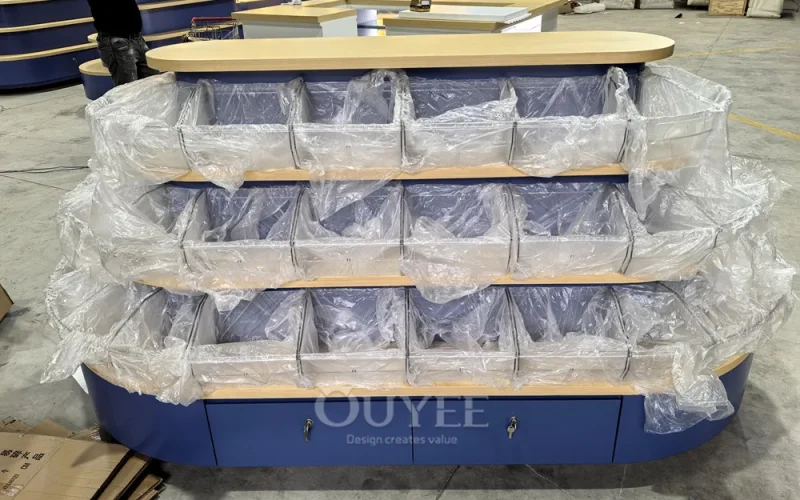
Before shipment, request a documented assembly check with the approved drawings beside the finished modules. Confirm door movement, locks, shelf positions, graphics, lighting operation, and the specified finish. Ask how modules are numbered and which fasteners or tools are supplied. Record the unpacking sequence so a decorative panel is not damaged while the base is being installed.
At the site, inspect the full selling sequence using actual stock. Refill the tester tray, retrieve a gift set, process a payment, and pack a purchase. Open the stock doors while another person occupies the service position. Check that staff can reset the display without placing cartons in the public route. Keep a short defect list with photographs and agreed responsibility for each item; appearance alone should not close the acceptance process.
Educational video: Sales and Service Counters, U.S. Access Board. Watch on YouTube.
Frequently asked questions
Which perfume kiosk fixture should I choose first?
Choose the service and tester counter first, using the approved footprint and selling sequence. Then add visible stock, tower displays, and storage around the customer approach and staff working route.
Is a U-shaped perfume kiosk better than a straight counter?
It depends on the site and staff route. A U-shaped kiosk offers several display faces but needs a usable entrance and internal working area. A straight counter can be simpler when sampling and payment share one supervised service side.
Can a product photograph confirm the kiosk will fit my mall?
No. Use the photograph to discuss appearance and fixture roles. Confirm fit, access, fixing, signage, and power through project drawings based on the mall requirements and a site survey.
Should testers and sealed stock use the same storage area?
Plan them as different tasks. Testers need an organized sampling and cleaning setup; sealed stock needs clear identification and retrieval. They may share a module only when those tasks remain separated and practical.
What should a perfume kiosk quote include?
Ask for module quantities, materials, finish samples, glazing, locks, lighting scope, graphic changes, packaging, installation responsibilities, and delivery assumptions. Compare those details against the same approved brief.

 English
  German
  Arabic
  French
  Spanish
  Italian
  Russian
  Turkish
  Portuguese
  Japanese