
A perfume tester bottle anti slip insert should be approved with the actual tester bottle, the proposed counter surface and the store’s cleaning routine. Check that the bottle sits evenly, lifts out without catching and returns to its intended position without moving the insert. Repeat those checks after the approved cleaning process. A soft-looking pad or close-fitting opening does not establish safe performance. This guide gives retail buyers a practical sample-review sequence for discussing removable inserts with a fixture supplier. It does not assign a universal clearance, friction value or guarantee against tipping, and it does not treat a countertop accessory as theft protection.
Separate bottle location from bottle security
Start by writing the problem in ordinary store language. Perhaps a tester drifts away from its label during repeated use. Perhaps staff struggle to return an unusually shaped bottle to a shared tray. These are useful observations because they identify movements to examine. “Make every bottle secure” is too broad to turn into an approval test.
A flat liner, a shaped opening and a mechanically retained holder have different functions. An insert intended to help locate a bottle may still lift with it, rotate during use or allow a tall bottle to tip. Decide whether customers should lift the tester freely, whether staff should supervise retrieval and whether a separate security system is required. Have the supplier explain the proposed accessory’s intended function in writing.
For the wider choice of backwalls, islands and tester counters, use our perfume retail display buying guide. The review below concerns the bottle-to-insert interface after the display format has been selected.
Use a real counter reference without assuming an insert is included
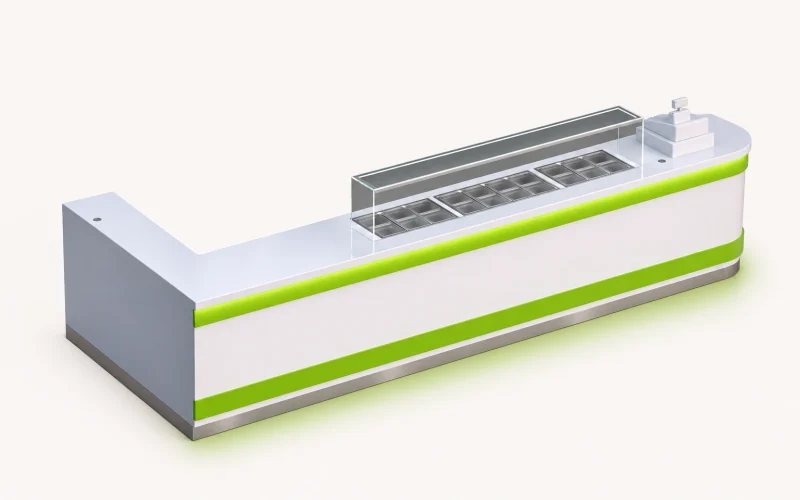
The Ouyee oval tester counter and perfume backwall provides a real fixture reference for this discussion. Its product photographs show a stepped oval island, reflective gold-colored edges, white work surfaces and illuminated shelving. Those visible features help buyers discuss placement and handling space. They do not prove the presence of a non-slip liner, a particular surface chemistry or a tested bottle-retention accessory.
Ask for a separate accessory proposal if an insert is required. It should identify the contact material, thickness, edge treatment, attachment method and removal procedure. The illustration below retains the real counter’s visible form; the bottles demonstrate a planning question, not a completed installation or evidence of tested performance.

Build a sample set around actual bottle bases
Do not approve an insert from fragrance volume or a catalog silhouette. Record the actual tester’s base outline, contact areas, overall height, cap arrangement and any projecting label or decorative feature. Identify the sample by its current packaging revision so a later bottle change does not inherit an unsuitable approval.
Include the shapes that challenge the proposed design: a narrow base, an asymmetric bottom, a broad square body and a bottle with an awkward grip. Use the actual intended fill condition when the retailer and bottle supplier approve it. If substitutes are used for an early fit discussion, record that limitation and return to representative production testers before approval.
Inspect the bottle and the counter before starting. Existing chips, loose caps or damaged decoration can confuse the results and make handling inappropriate. Protect valuable samples and stop a check before it creates a falling or breakage risk. The Ontario museum object-handling guidance supports planning handling and supporting objects on stable surfaces. It is general handling guidance, not a retail fixture test standard.
Review fit, lifting and return as separate checks
Begin on a stable, level sample counter with a clean, dry surface. Position the proposed insert exactly as its supplier intends. Observe whether it lies flat and whether its edges interfere with the worktop, nearby signs or the next tester position. A corner that curls up deserves investigation before bottles are added.
Place one bottle without forcing it into position. Look for rocking, uneven support, contact with decoration and unwanted pressure on the pump or cap. A shaped pocket should not disguise poor support underneath the bottle. Ask the supplier to explain how bottle variation is accommodated; do not choose a clearance by guesswork.
Next, lift and return the bottle using the intended customer or staff movement. Observe whether the insert follows the bottle, catches on the base or shifts across the counter. Repeat with neighboring positions occupied to reveal hand-space conflicts. Record the movement that caused difficulty rather than simply marking the sample “unstable.”
Keep informal sample checks controlled and non-destructive. Do not tip a loaded counter, push a glass bottle toward an edge or describe a casual demonstration as a certified friction test. Where measured retention or stability performance is required, ask a qualified test provider and the supplier to agree on a suitable method and acceptance limits.
Keep a written decision table for each combination
The following is a buyer’s sample-review worksheet, not a published test standard. Use one record for each bottle, insert and surface combination. Write the agreed method and the people responsible before deciding whether a result is acceptable.
| Review point | What to observe | Decision or follow-up |
|---|---|---|
| Base contact | Bottle rests evenly without forcing or rocking | Review the support geometry if contact is uneven |
| Normal lifting | Bottle clears the insert without catching | Revise the opening or retrieval method if it binds |
| Insert movement | Insert stays in its intended position during use | Investigate the proposed attachment and surface pairing |
| Neighbor access | Hands can retrieve a tester without contacting another bottle | Adjust spacing and repeat with the full sample set |
| Approved cleaning | No visible residue, distortion, sticking or surface change | Stop use and seek material-specific instructions if changed |
| Replacement | Staff can identify and fit the correct replacement part | Confirm part reference, revision and replacement supply |
Check material compatibility before approving a cleaning routine
Ask for the insert’s actual material identification and written care instructions. “Rubber,” “foam” and “plastic” describe broad families, not a complete compatibility specification. Obtain instructions for the worktop and bottle decoration as well, because the proposed cleaning process affects more than the removable part.
The Canadian Conservation Institute’s guidance on rubber and plastic care explains that composition and condition matter when assessing these materials. Its museum guidance provides a reason to ask precise material questions; it does not certify a modern retail insert or prescribe a disinfectant for perfume counters.
Test the supplier-approved procedure on an agreed sample combination. Record the cleaning product, application method and drying conditions. Examine the insert and the surface beneath it before returning the tester. Look for visible changes such as tackiness, color transfer, swelling, an altered edge or residue. Do not improvise solvent mixtures or assume that fragrance exposure and cleaning-agent exposure are interchangeable.
Keep spills separate from routine cleaning approval. Staff need the fragrance supplier’s handling information and the store’s spill procedure. An insert that traps liquid can make an otherwise accessible surface harder to inspect. Ask how the accessory is removed safely and how staff verify that the underlying worktop is ready for use.

Observe handling before changing materials
A persistent problem may come from the arrangement rather than the insert material. Watch a supervised demonstration of reaching, lifting, spraying where permitted and returning the tester. Check whether the customer has a clear place to set the cap and whether a sign obscures the return position. Revise one feature at a time so the next review can explain what improved.
The National Museums Scotland object-handling resource emphasizes considering the object and the handling task. That principle is relevant to a glass tester review, although museum procedures should not be adopted as retail operating requirements.
The British Museum’s video below explains why handling choices depend on the object and task. It offers useful background on careful object handling; it does not demonstrate perfume inserts or validate their slip resistance. Store staff should follow their own approved handling procedure.
Watch the British Museum object-handling video on YouTube.
Approve a defined sample, then control changes
Keep the approved bottle list, insert drawing revision, material reference, counter finish sample and photographs together. Record limitations as carefully as successes. A suitable accessory for one tester range should not silently become the approved solution for every future bottle.
Before ordering, confirm replacement availability, cleaning access, the store contact responsible for inspection and the conditions that trigger a new review. Changes in bottle base, fill condition, material, cleaning product or surface finish should return to the responsible supplier for assessment. Label sample approval clearly so it cannot be mistaken for an unlimited performance guarantee.
Bring these records into the broader perfume kiosk fixture review and the project’s perfume store planning discussion. For open shelves, review shelf-edge retention separately: an insert’s sample fit does not establish edge protection.
Frequently asked questions
Does a non-slip insert stop a tester bottle from tipping?
That cannot be assumed. Location, sliding and tipping are different behaviors. Review the actual bottle, accessory and counter combination, and obtain agreed performance evidence if a specific stability claim is required.
Can one insert fit every perfume bottle?
Approve only the bottle shapes and revisions included in the sample review. A changed base, projecting decoration or different retrieval movement can require a revised accessory and another check.
Should the bottle fit tightly into a shaped opening?
It should fit according to the supplier’s approved design while allowing the intended handling movement. Forcing a bottle into a pocket or accepting a binding lift is a reason to stop and review the sample.
Can staff clean an insert with any alcohol-based cleaner?
No universal compatibility follows from the accessory’s appearance or material family name. Obtain written instructions for the insert, worktop and bottle finish, then verify the agreed cleaning process on representative samples.
What should accompany an insert quotation?
Provide the tester sample list, base details, intended counter surface, retrieval routine and cleaning requirements. Request the accessory drawing, material identity, attachment method, replacement reference and a written sample-approval procedure.










 English
 German
 Arabic
 French
 Spanish
 Italian
 Russian
 Turkish
 Portuguese
 Japanese