
Bakery cake pickup shelf order identification works best when every reserved order has one unique order number, every storage position has a separate location code, and a staff member matches the order to the customer before release. Keep the order number unchanged when a box moves. Record its new location instead. A pickup shelf organizes the collection process; it does not establish safe holding conditions. Cakes that require refrigeration must remain in suitable temperature-controlled storage under the bakery’s food-safety procedures until the appropriate handoff step.
This guide explains how to brief a fixture supplier, test boxed-cake clearance, and connect the shelf to an everyday collection routine. It addresses reserved orders rather than general pastry merchandising. For the wider counter arrangement, start with our bakery kiosk fixture selection guide.
Separate order identity from shelf position
A customer’s name is useful during conversation, but names repeat and pickup times change. Use the order reference already created by your ordering system or controlled order book. Put the same reference on the box and the staff record. A shelf location such as A2 tells staff where to look; it must not become a replacement order number.
For example, order BK-318 can be recorded at ambient position A2 only if that product is suitable for the bakery’s approved ambient holding procedure. Another package belonging to BK-318 might be in refrigerated position R4. The order record links both packages. If staff move the first box to A3, they change the location entry, not the identity printed on the box. These codes are illustrative, not a required industry standard.
A compact pickup record should include the order number, collection date and agreed window, package count, storage location, readiness status, and responsible staff member. Keep payment questions and substitutions visible to staff. Avoid placing customer phone numbers, addresses, or detailed private notes on a public-facing shelf label.
Choose the holding location before assigning the slot
Do not begin by asking how many cake boxes fit on an open shelf. First ask which finished products may be held there under your actual recipes, packaging, operating procedure, and local requirements. A closed cardboard box protects a cake from some handling damage, but it does not make a perishable filling suitable for room-temperature holding.
The Food Standards Scotland CookSafe house rules connect temperature control, stock identification, and storage practices. They provide useful planning principles; Scottish guidance does not replace the requirements of a bakery in another jurisdiction. Assign a food-safety lead to approve the holding method before the fixture layout is signed off. Use a written product list to distinguish the different bakery goods and display needs handled at your counter.
| Order situation | Location and record | Release check |
|---|---|---|
| Boxed product approved for ambient holding | Dedicated clean slot; record order number and package count | Match reference and confirm the complete order |
| Cake requiring refrigeration | Suitable refrigerated storage; pickup record points to its actual location | Retrieve through the bakery’s approved cold-holding and handoff procedure |
| One order stored in two places | List each package and location under the same reference | Count all packages before marking collected |
| Box moved during a busy period | Update the location immediately; keep the order number | Use the latest recorded location, not memory |
| Unclear label, damage, or unresolved request | Hold for staff review in appropriate storage | Resolve the discrepancy before release |
This is an operational decision table, not a food-safety approval. In the United States, the FDA Food Code is a model used by regulatory authorities. Confirm the rules adopted for your location instead of assuming one national document automatically governs every bakery.
Size the shelf around the complete package
Measure the finished box with its board, handle, ribbon, protective corners, and any outer carrier. Record the largest package you actually accept, alongside the common daily size. A drawing showing an overall counter width is insufficient: ask for the clear opening, usable depth, vertical clearance, and any obstruction at the front of the proposed storage position.
Use empty packaging during the first fit test. Slide a box into place, remove it with both hands, turn toward the handoff surface, and set it down without touching an adjacent package. A box that technically fits but must be tilted, scraped, or pulled by its lid has failed the practical trial. Recheck after adding the real label holder, because that accessory can reduce the usable opening.
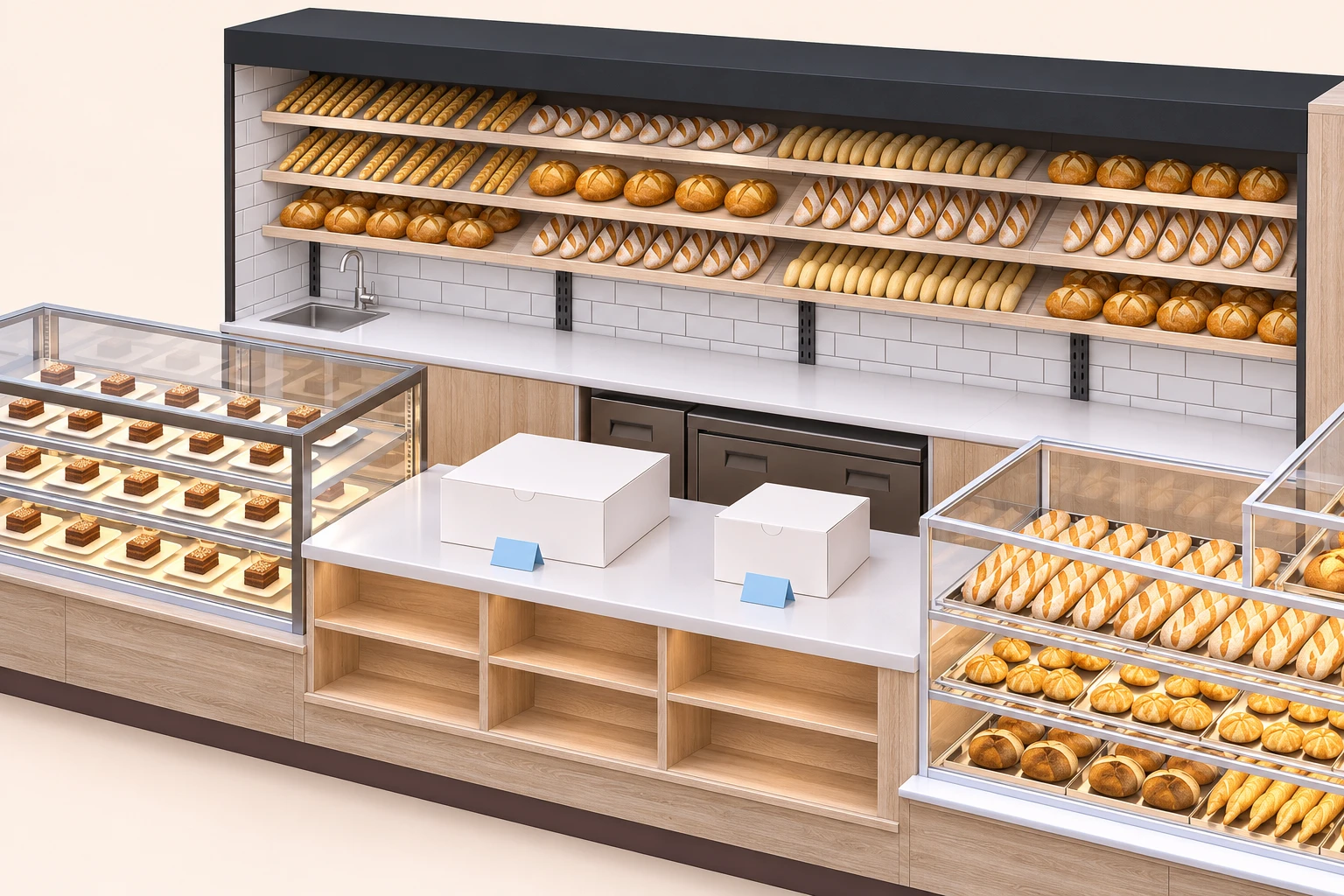
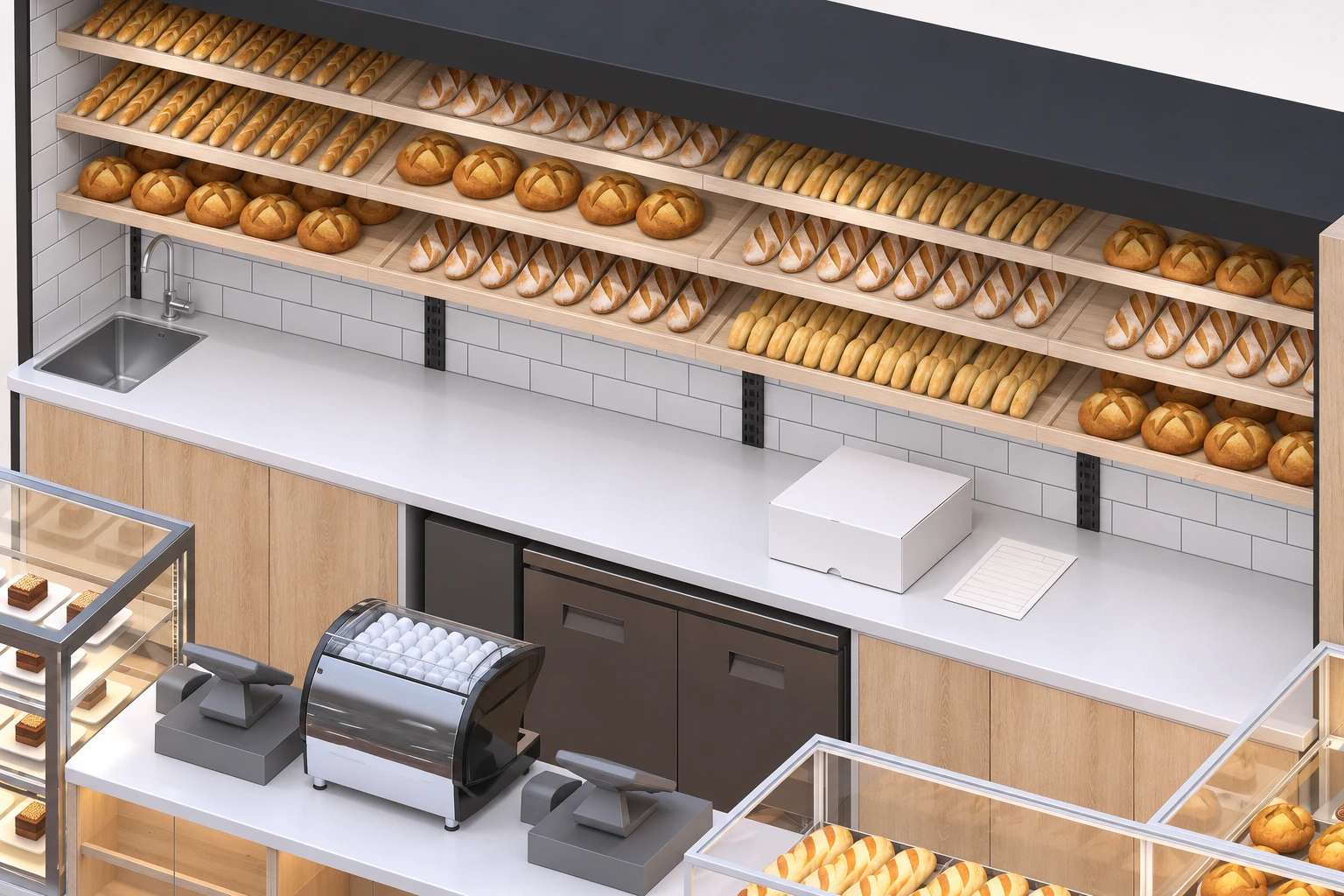
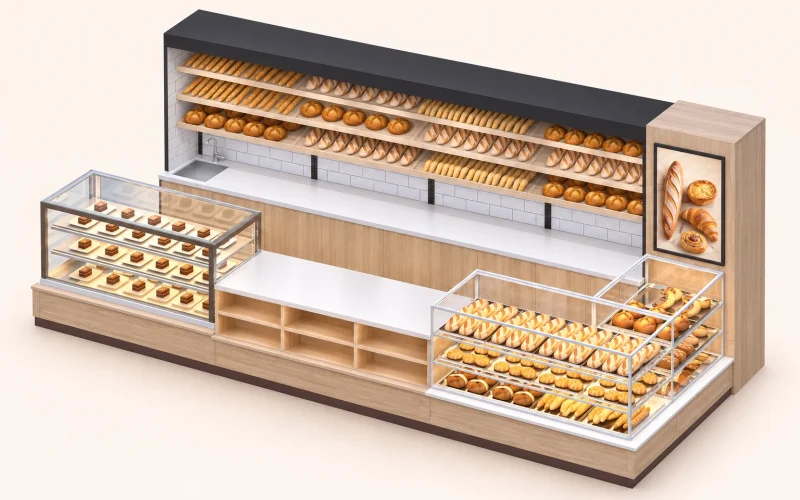
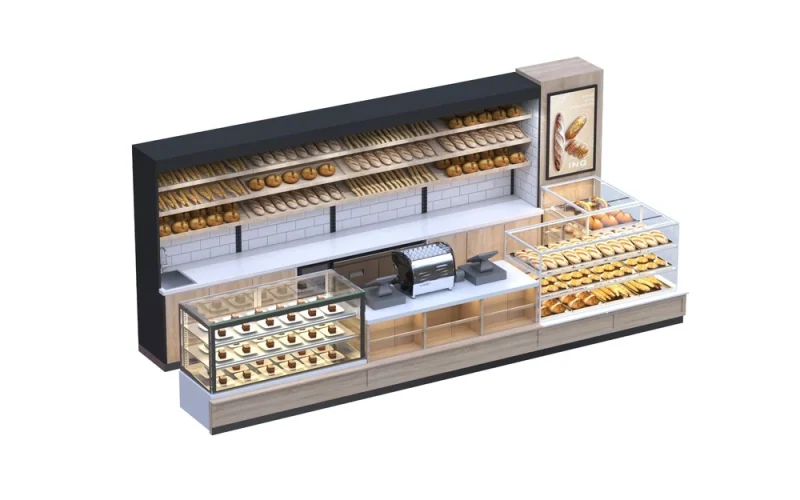
The wooden bakery counter with glass showcases provides a real reference for coordinating display cases, a central service worktop, and open compartments. Its product images do not verify a specific cake-box capacity, load rating, or refrigerated function. Request project drawings and written confirmation for the proposed configuration; do not infer those properties from a rendering.
Plan capacity from simultaneous orders
Daily order totals are a poor starting point for shelf capacity. Map how many packages will be present at the same time during the busiest collection window. Include early-ready orders, late customers, and orders with more than one box. Separate ambient package demand from refrigerated storage demand so spare ordinary shelving is not mistaken for spare cold capacity.
For an illustrative planning exercise, suppose eight ambient orders await collection and three have two packages. That is eleven package positions before any contingency allowance. This simple count is not a prescribed capacity margin. Repeat the exercise with your own collection history, package sizes, and acceptable waiting arrangements, then test the layout at that peak condition.
Agree on an overflow rule before opening. Staff should know the approved alternative storage location, how to record a move, and who can authorize it. Do not place overflow boxes on the floor, in the customer queue, or on a surface needed for a different food-handling task. Review the broader bakery floor-plan zones when collection begins to compete with ordering and payment.
Make the handoff a short, repeatable sequence
Give collection customers a clear point to approach without reaching across the display or entering the staff work area. In a small bakery, collection and payment may share a counter, but staff still need a defined space where the reserved order can be checked. A “ready” status means the order has completed the bakery’s preparation checks; it should not merely mean a label has been printed.
- Ask the customer for the order reference and confirm it against the staff record.
- Locate every package, including any item stored separately under refrigeration.
- Check the box reference, item description, package count, and outstanding instructions against that record.
- Resolve payment, substitutions, damage, or any mismatch before completing the handoff.
- Record collection and clear the location only after the complete order has been released.
Include a procedure for someone collecting on behalf of the purchaser. Tell customers the information they need in advance and apply the same check consistently. Do not improvise identity documents or personal-data collection unless your business has established a justified procedure. Clear communication before arrival often prevents more confusion than additional shelf signs.
Keep identification, hygiene, and allergen information connected
A pickup code cannot communicate all the information required about a cake. Keep required product information and any handling instructions with the correct package. An internal location label supplements those details. If several boxes belong to one order, staff must still be able to distinguish the individual contents without opening each box in front of the customer.
Allergen requests need the bakery’s established review and communication process. A colored tag is an additional prompt, not proof that a product is free of an allergen. Staff should stop and resolve a mismatch between the order record, package information, and customer request. Never swap a label between boxes to make the paperwork appear consistent.
The University of Maine’s cross-contamination lesson explains why handling practices matter. Use it as a training aid when deciding how staff move between payment, packaging, and collection tasks. A clean-looking fixture alone cannot demonstrate that the whole handling process is controlled.
Further learning: Cross Contamination, The University of Maine. This educational video supports hygiene training; it does not certify a shelf or replace the bakery’s procedures.
Test the layout before approving the fixture order
Run a tabletop trial with two staff members and realistic empty packages. Include two customers with the same first name, a moved box, an early arrival, a late arrival, a split-storage order, and an unreadable tag. A successful test lets the second staff member find and check each order from the record without relying on the first person’s memory.
Send the supplier a marked floor plan, package dimensions, expected simultaneous package count, proposed location codes, cleaning-access requirements, and the handoff sequence. Identify which features are confirmed and which require drawing approval. Ask how label holders attach and whether they interfere with cleaning or box removal. For a coordinated project brief, see our bakery store fixture solution.
After opening, log wrong-location incidents, missing packages, and collection delays. Review the causes with staff before adding more shelving. A larger shelf will not correct inconsistent order references or a process that marks an incomplete order collected.
Frequently asked questions
Should a cake order number be the same as its shelf number?
No. Keep the order number stable and record the shelf position separately. That allows staff to move a box without losing its connection to the customer and the remaining packages.
Can refrigerated cakes wait on an ordinary pickup shelf?
An ordinary shelf does not provide refrigeration. Keep cakes requiring temperature control in suitable storage and follow the bakery’s approved food-safety and collection procedure.
What should staff do when one order has several boxes?
Record the total package count and every storage location under one order reference. Collect and check all packages before marking the order released.
How can a bakery check box clearance before buying a counter?
Use the complete empty packaging to test the proposed clear opening, usable depth, and removal path. Confirm dimensions and loads with the supplier rather than estimating them from product photographs.
Is a colored allergen tag sufficient for cake collection?
No. A colored tag is only a prompt. Staff must use the bakery’s established allergen information and communication procedure and resolve discrepancies before release.




 English
 German
 Arabic
 French
 Spanish
 Italian
 Russian
 Turkish
 Portuguese
 Japanese