
To choose ice cream kiosk display fixtures for mall and event operators, start with the menu, service sequence, approved footprint, and actual refrigeration equipment. Then compare counters, topping displays, storage, signage, and service access as one working system. A visually attractive kiosk can still be a poor purchase if it blocks condenser airflow, leaves no space for cleaning, or sends customers across the staff replenishment route. Decide which equipment the fixture supplier includes and which items another contractor supplies before comparing prices. This guide focuses on purchasing the kiosk furniture and display system; refrigeration performance, food approval, and site services need separate evidence.
Write the operating brief before choosing a kiosk shape
List the products you will actually serve: scooped gelato, packaged ice cream, soft serve, rolled ice cream, drinks, or a combination. These formats use different equipment and staff movements. A scoop-and-pay kiosk needs a comfortable view into the display cabinet and a clear handoff point. A preparation-led concept needs more working surface, equipment access, and separation between ordering and production. Adding every possible menu item to the first drawing usually makes the service route harder to operate.
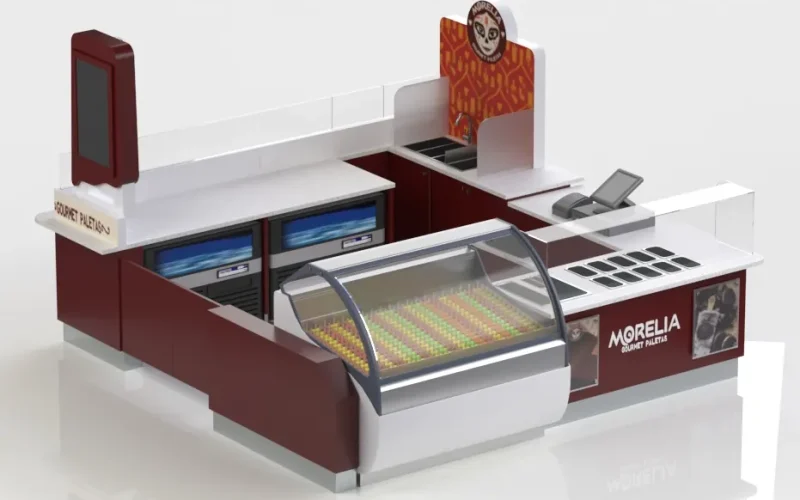
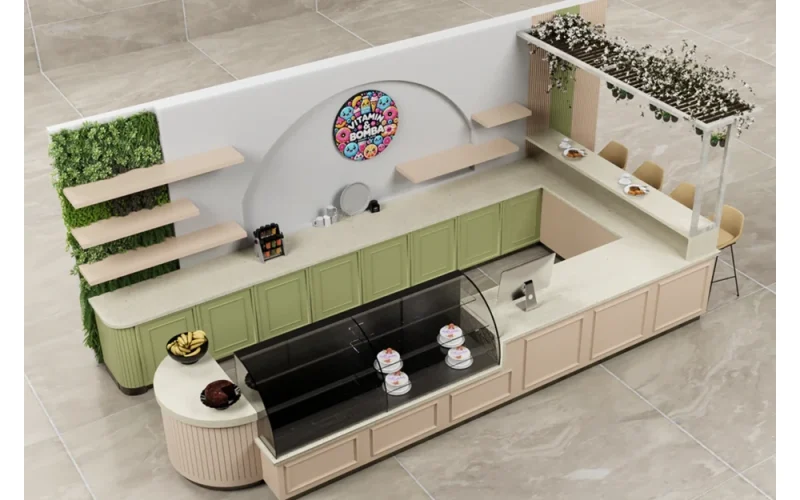
Describe one normal order from arrival to collection. State where customers read the menu, choose flavors, pay, wait, and receive their order. Mark the staff route for restocking cups, cones, packaging, and product. Include the cleaning and closing routine. The supplier should respond with a layout that supports this sequence rather than a decorative counter with equipment placed wherever it fits. Use the ice cream kiosk product overview to discuss configurations, while keeping your own approved menu and equipment list as the project baseline.
Match the fixture system to the service format
| Operating format | Fixture priority | What to verify before buying |
|---|---|---|
| Scooped ice cream or gelato | Clear cabinet viewing, cone storage, scoop handling and pickup | Actual cabinet dimensions, lid movement, staff reach and customer sightlines |
| Soft serve | Machine access, cup storage and a clear finishing counter | Machine service clearance, dispensing position and supplier responsibility for utilities |
| Rolled ice cream | Preparation surface, ingredient handling and a visible production zone | Cold-plate installation requirements, splash protection and cleaning access |
| Packaged products | Readable product display and orderly payment | Freezer opening clearance, labels, restocking route and basket handling |
| Temporary event service | Practical assembly, transport protection and site connection planning | Organizer approval, handling method, repeat assembly and temporary-service requirements |
This is a qualitative buying comparison, not a specification for refrigeration or food safety. For a broader equipment inventory, review equipment used in an ice cream shop. Use the exact manuals for your chosen appliances when determining installation space and services; a similar-looking machine is not a reliable substitute.
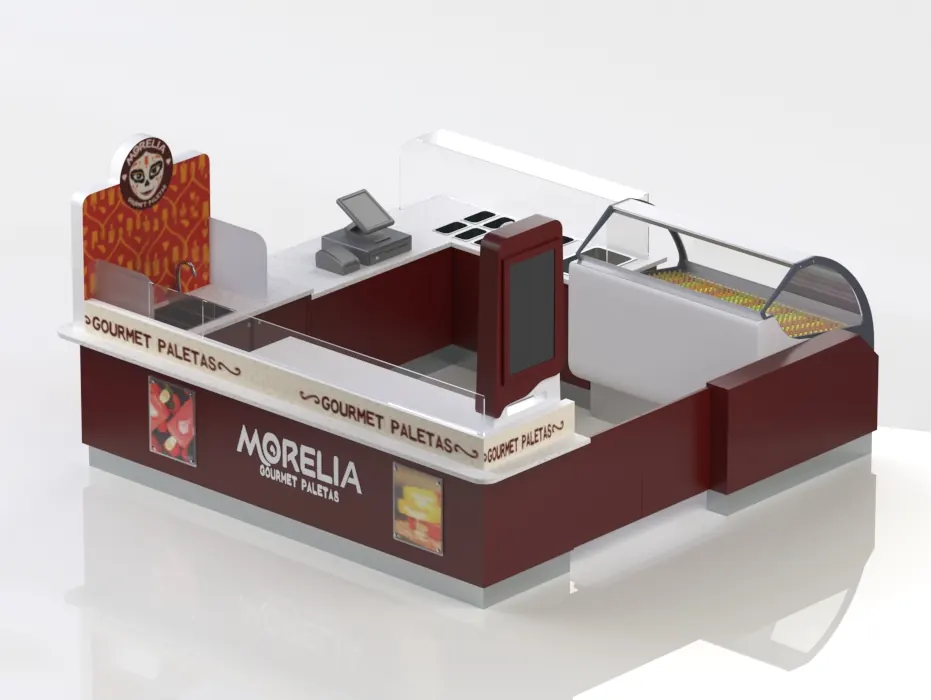
Separate the display counter from the refrigeration decision
The furniture envelope and the cold equipment have different jobs. The kiosk frame supports the service arrangement and visual identity; the refrigerator must suit the product, operating environment, and approved installation. Ask for equipment manufacturer, model, cabinet drawing, installation manual, and the precise scope of supply. Do not accept a rendering of a freezer as proof that the quoted package includes one, or that the equipment can maintain the conditions required for your menu.
Confirm which panels are removable and how a technician reaches the refrigeration components. Drawings should show the appliance ventilation requirements and the route for withdrawing equipment without dismantling the whole kiosk. Ask the equipment supplier to confirm any proposed enclosure. A neat front panel should not cover required openings. Position lighting and brand graphics so they do not obstruct lid operation, temperature displays, handles, or access needed for inspection.
The FDA Food Code resource provides a model framework for retail food controls. It does not replace the rules adopted by the authority responsible for your site. Have that authority review the relevant layout and operation before manufacturing. This article does not assign a universal holding temperature or certify any illustrated kiosk for food service.
Approve the landlord footprint and the customer route
Obtain the mall or venue requirements before freezing the layout. Identify the leased boundary, permitted sign positions, service connection points, restrictions on floor fixing, and equipment access during delivery. Show door swings and staff openings on the drawing. The usable footprint includes these movements, not merely the outside dimensions of the counter when everything is closed. A kiosk that fits its rectangle may still obstruct neighboring circulation during a busy service period.
Check views from the main approach routes. Customers should understand what is sold, where to order, and where to collect without circling the kiosk or entering staff space. Keep the payment position separate from the most active replenishment path. For a small operation, an obvious pickup point can be more useful than adding another decorative display. The ice cream shop layout guide offers broader planning context; a kiosk needs its own landlord-approved drawing.
Review the customer route and service counter against applicable accessibility requirements. The U.S. Access Board sales and service counter guidance explains relevant counter and approach provisions. Applicability depends on the facility and work involved. Have the project professional confirm the required dimensions and approach arrangement rather than using a product image as evidence of compliance.
Plan toppings, cones and packaging around actual handling
A topping station is useful only when staff can portion, replenish, and clean it without crossing orders. Decide whether toppings are staff-served or customer-accessible before selecting display hardware. Establish the required protection and handling arrangements with the food authority. Drawers and cupboards should store the real containers and packaging you use, with enough space to grasp and remove them. Ask for internal usable dimensions; external cabinet size does not establish storage capacity.
Try the proposed layout with representative cups, cones, napkins, scoop holders, delivery containers, and waste receptacles. Identify where opened packaging stays during service. Keep the order handoff clear of cleaning materials and restock cartons. Locate consumables where employees can reach them during a normal order. These small decisions often determine whether the kiosk works comfortably when more than one employee is present.
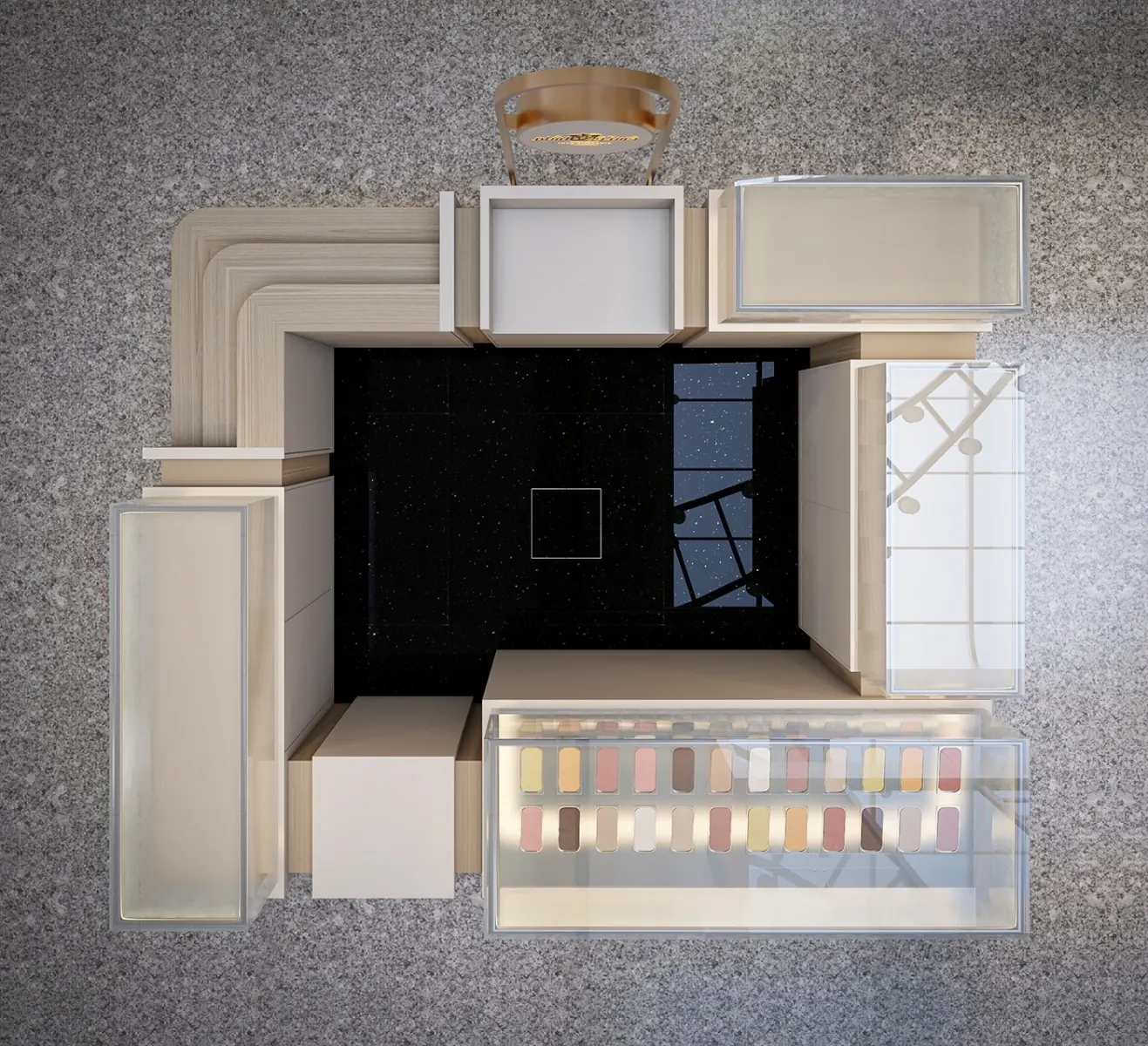
Choose surfaces and joints that can be maintained
Ask the supplier to identify the materials, finishes, edges, joints, and hardware in the quotation. Separate customer-facing decorative surfaces from areas exposed to water, food handling, or repeated cleaning. A finish sample should be checked with the cleaning products and methods approved for that surface. Do not assume every glossy panel has the same resistance or that a sample establishes the suitability of the entire assembly.
Inspect seams, corners, cable openings, base details, and removable panels. Establish how spills are reached and removed, how damaged edges can be replaced, and which parts are supplied as spares. Review glazing edges and supports with the supplier and project professional. A claim such as “food grade” should identify the relevant material and intended use; it is not a blanket approval for a complete kiosk or a substitute for local review.
Distinguish mall installations from event use
A mall kiosk often stays in one approved position with a defined service arrangement. An event fixture may be transported, assembled, cleaned, and stored repeatedly. If you need both uses, state that requirement at the start. Ask how modules are connected, how panels are protected in transit, what equipment remains attached, and which components require separate handling. A modular appearance does not prove that an assembly can safely be moved while loaded.
For events, provide the organizer’s site conditions and access information. Outdoor exposure, temporary electrical connections, water supply, wastewater handling, and uneven ground need separate professional and authority review. Do not take an indoor mall rendering as proof of outdoor suitability. Agree on a setup checklist and the responsibilities of the operator, fixture supplier, refrigeration contractor, and event organizer before approving the purchase.
Make menu boards and lighting support the order
Use a representative menu to check text visibility from the ordering approach. Group choices so customers can decide before reaching payment. Keep graphics away from staff sightlines and maintenance openings. State whether sign frames, illuminated lettering, digital screens, and their installation are included. For digital equipment, document the mount, service access, cable route, and responsibility for content separately from the cabinet quotation.
Review lighting on the actual finish sample and representative merchandise. Avoid glare that makes the cabinet difficult to see into or reflections that hide labels. The equipment supplier should confirm lighting installed within refrigeration equipment. For decorative kiosk lighting, request component identification and the approvals appropriate to the installation. Photographs help compare presentation, but they do not establish brightness, equipment performance, or an electrical approval.
Compare complete supplier quotations
Send every shortlisted supplier the same fixture schedule, equipment list, finish brief, and delivery conditions. Require a line-by-line scope identifying furniture, glazing, refrigeration, signs, lighting, plumbing fixtures, installation, packing, delivery, and commissioning. Mark exclusions explicitly. A lower price may describe a narrower package. Compare the delivered and usable system, including the work another contractor must complete, rather than the furniture subtotal.
| Teklif maddesi | İstenilen kanıtlar | Acceptance question |
|---|---|---|
| Layout and counters | Dimensioned approved drawing and module schedule | Does each item match the agreed footprint and operating sequence? |
| Ekipman arayüzü | Named models, installation manuals and scope boundaries | Can the equipment be installed, ventilated and serviced as required? |
| Finishes and glazing | Material identification, samples and relevant supporting documentation | Do delivered materials match the approved samples and intended use? |
| Signs and lighting | Component list, mounting details and responsibility schedule | Are graphics readable and components accessible for maintenance? |
| Delivery and assembly | Packing list, handling plan and site access requirements | Can modules reach the site and be assembled without unexpected work? |
| After-sales support | Warranty scope, spare parts and contact procedure | Who resolves a cabinet fault, appliance fault or installation issue? |
Kullanın supplier and vendor selection guidance for the wider business relationship. Keep the fixture purchase tied to written drawings, samples, and acceptance evidence rather than an informal promise to match a reference photograph.
Run a sample service and delivery acceptance check
Before manufacturing the complete kiosk, review a representative counter module or agreed sample assembly. Rehearse an order, replenishment, cleaning, and technician access with the real equipment and consumables where possible. Record every agreed change on the drawing. If a physical mockup is unavailable, document the limits of a drawing review; a rendering cannot prove reach, comfort, cleaning access, or equipment performance.
At delivery, inspect modules against the packing list and approved drawings. Check visible damage, edges, doors, drawers, panel access, fixings, and finish consistency. Have qualified contractors verify services and equipment commissioning. Keep the agreed documents, photographs, and supplier contacts together so a later repair has a clear reference. Open only after the approvals and operating checks required for your location are complete.
Educational video: accessible sales and service counters
This U.S. Access Board video explains sales and service counter accessibility. Use it to understand the customer service area of the kiosk, alongside the written guidance and project-specific review. It does not approve the illustrated products or address refrigeration and food preparation requirements.
Satış ve Servis Tezgahlarını YouTube'da İzle.
Sıkça Sorulan Sorular
Öncelikle neyi seçmeliyim: kiosk tasarımı mı yoksa ekipman mı?
Montaj çizimini onaylamadan önce menüyü tanımlayın ve amaçlanan ekipmanı seçin. Son kiosk, onaylanan müşteri ve personel güzergahlarıyla birlikte, tam cihaz boyutları, havalandırma, işletme ve servis gereksinimlerini karşılamalıdır.
Does an ice cream kiosk quotation normally include refrigeration?
Bunu varsaymayın. Bir isimlendirilmiş ekipman listesi ve hangi tesisatçının ne sağladığını, başka bir müteahhitin ne temin ettiğini ve her öğenin kim tarafından kurulduğunu ve devreye alındığını gösteren yazılı kapsam talep edin.
Aynı kiosk alışveriş merkezinde ve açık hava etkinliklerinde kullanılabilir mi?
Sadece amaçlanan kullanımlarını, taşıma yöntemlerini, saha koşullarını ve onayları gözden geçirdikten sonra. Bir iç alışveriş merkezi tasarımı, açık hava uygunluğunu veya geçici etkinlik gereksinimlerine uyumu sağlamaz.
How can I check whether the counter layout works?
Temsilci ekipmanlar ve tüketim malzemeleri kullanarak sipariş verme, ödeme, tahsilat, stok yenileme, temizlik ve servis erişimini prova edin. Bulguları onaylı çizime kaydedin ve proje uzmanıyla uygun erişilebilirlik gereksinimlerini doğrulayın.
Bir kiosk satın aldıktan sonra hangi belgeleri saklamalıyım?
Onaylanmış çizimleri, ekipman kılavuzlarını, malzeme ve bitirme takvimini, tedarik kapsamını, ambalaj listesini, devreye alma kayıtlarını, garanti şartlarını ve yedek parça iletişim bilgilerini saklayın. Bu belgeler teslimat kabulü ve sonraki bakım için destek sağlar.

 Turkish
  English
  German
  Arabic
  French
  Spanish
  Italian
  Russian
  Portuguese
  Japanese