
A clothing store checkout shopping bag dispenser should match the bags your staff actually use, release them without repeated pulling, and leave enough room for garment packing and replenishment. Start with physical bag samples and a full-size counter mock-up before specifying a rack, tray, or concealed compartment. A dispenser that fits an empty cabinet can still obstruct a drawer, catch bag handles, or force an awkward reach when stocked.
This guide focuses on bag storage and refilling at fashion checkout counters. It separates the host furniture from the optional dispensing accessory, explains what to measure, and gives a practical acceptance test. It does not prescribe a universal mounting size or assume that a pictured counter includes a bag dispenser.
Start with the bag, then choose the holder
Collect one current production sample of every bag used at checkout. Include the small accessory bag, regular clothing bag, largest garment bag, and any seasonal gift packaging. Samples from a supplier catalogue are less useful than the actual delivered bags because folds, handles, reinforcement patches, and surface texture affect how a stack behaves.
Record the folded width and height, the thickness of a representative stack, and the position of each handle. Check whether the bag arrives loose, in a hanging pack, or on a roll. A hook arrangement intended for one pack format should not be assumed suitable for another. A flat paper bag with rope handles needs a different trial from a perforated film roll.
Separate storage from opening. Some accessories hold a bag open for packing; others only present an unopened bag for removal. Decide which task the store needs. Calling both a “bag dispenser” can conceal a significant difference in counter footprint and staff movement.
Compare storage arrangements by their working envelope
Use the following table as a qualitative planning checklist. It describes proposed configurations, not accessories included with an Ouyee counter. Final mounting, dimensions, and load suitability require the accessory supplier and cabinet maker to agree on the actual design.
| Düzenleme | Bag format to trial | Space to check | Kabul sorusu |
|---|---|---|---|
| Removable open tray | Loose folded paper bags | Tray removal path and handle clearance | Can staff take one bag without disturbing the next size? |
| Countertop opening stand | Bags with compatible hanging points | Full stand footprint and opened bag | Does an open bag leave space for the garment and payment device? |
| Under-counter hanging holder | Supplier-approved hanging bag packs | Staff knee area, drawers, and replenishment direction | Can a full pack be loaded without reaching around moving hardware? |
| Roll holder | Compatible perforated rolls | Largest new roll and withdrawal path | Does separation work without dragging the holder or tearing the next bag? |
| Dedicated cabinet compartment | Separated folded bag sizes | Internal opening, door movement, and access to the last bag | Can the compartment be emptied and cleaned without dismantling the cabinet? |
A concealed option may free the visible worktop but also introduce a longer retrieval movement. An open tray may be simpler to replenish yet occupy space needed for folding a large garment. Test the whole packing sequence rather than ranking options by appearance alone.
Map the counter before proposing an attachment
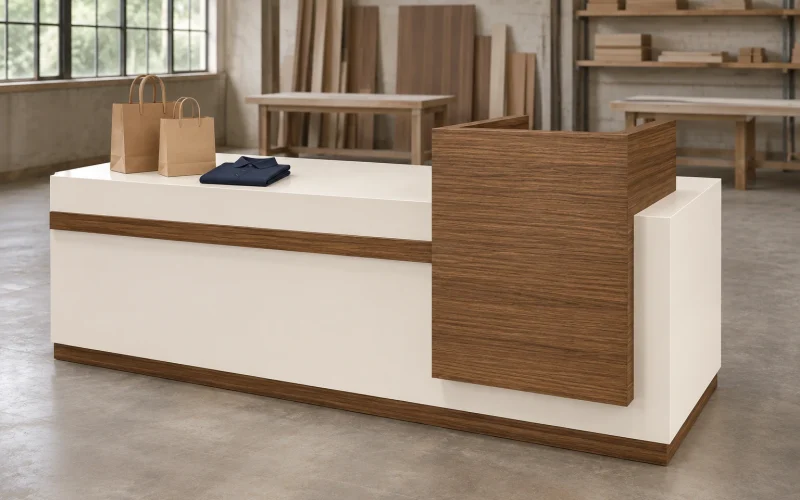
For a real host reference, the Butik Ödeme ve Bölücü Gösterim Seti includes a wood-and-white cashier counter in its image gallery. The visible front has a long white section and a taller wood-faced block. The photographs do not establish an internal bag compartment, a fixing substrate, or a tested accessory interface. Treat those as questions for a drawing review.
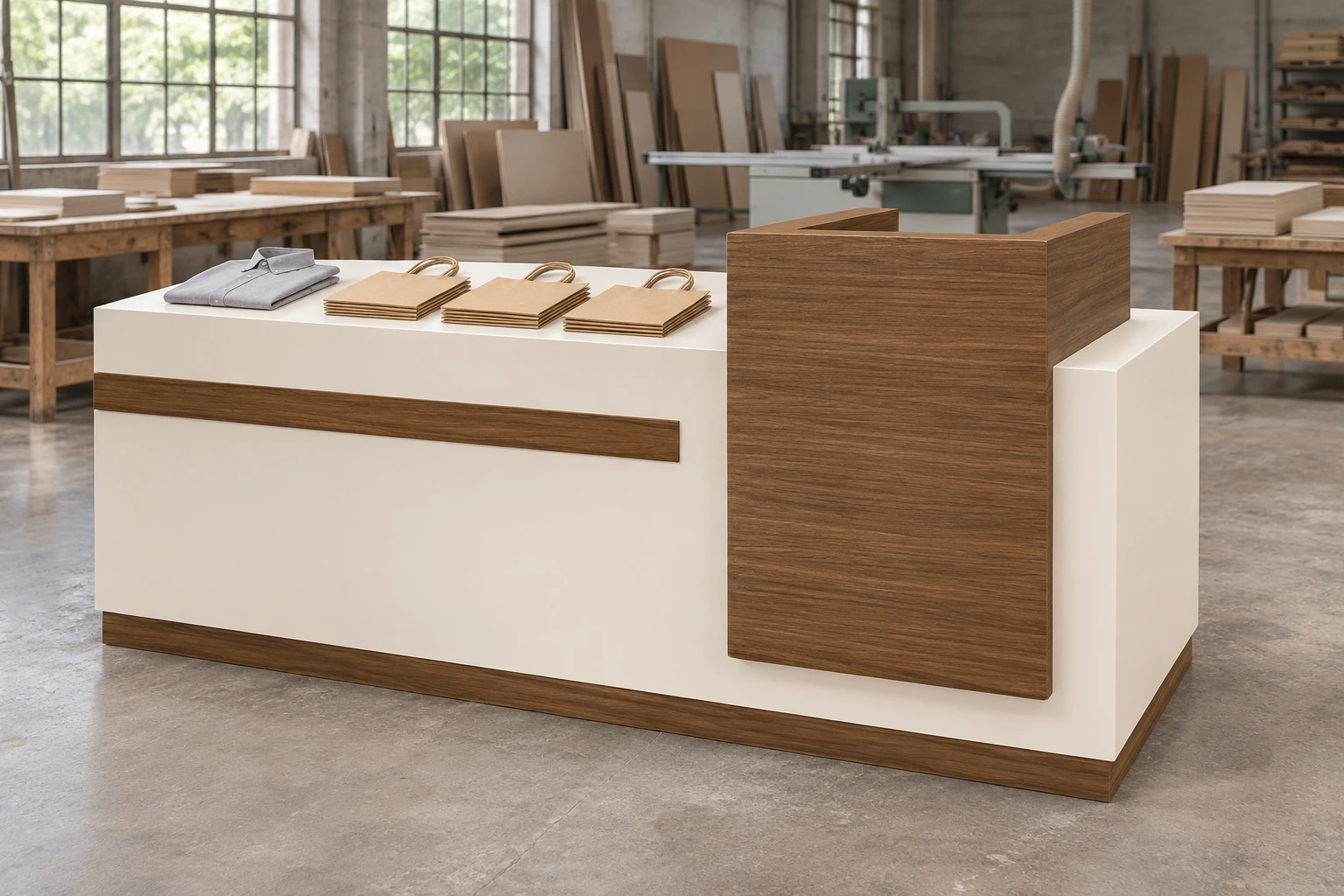
On the proposed counter drawing, mark the payment device, receipt printer, tag-removal equipment, cash drawer, staff entry, and garment packing area. Add any cables and service access already agreed for the project. Only then mark the bag retrieval and replenishment movements. A dispenser should not become a reason to move loose cables into an inaccessible space.
Ask for the usable internal opening rather than relying on overall cabinet width. Door hinges, drawer runners, support members, and equipment can reduce the space available. Do not drill a finished counter based on its appearance. Have the cabinet maker confirm where an attachment can be supported and whether it changes finish protection or access obligations.
The broader clothing store fixtures buyer’s guide helps coordinate the counter with the surrounding furniture. Keep that overall layout decision separate from the smaller bag-format trial.
Check reach with the people who will use the station
Invite staff with different working heights to try the proposed position. Begin with the ordinary sequence: receive a folded garment, select a bag, open it, pack the purchase, and pass it to the customer. Watch where feet, shoulders, and hands move. Ask whether the bag location encourages a repeated twist or a reach behind the body.
The Canadian Centre for Occupational Health and Safety’s standing-work guidance supports arranging frequent operations within easy reach and avoiding uncomfortable reaching. It is a general workplace resource, not a certification of a particular checkout design. Apply it through a task observation rather than copying a single desk measurement.
Also trial the less frequent but more disruptive events: retrieving the largest bag, reaching the final bag in a compartment, and replacing a full stack. If the layout only works for the first few bags at the front, it has not passed. Move the sample holder and repeat the sequence before approving cabinetry.
A NIOSH evaluation of a grocery express checkout identified workstation reach and posture concerns in that specific setting. It is historical evidence from a different retail task, so it should not be treated as a clothing-store dimensional standard. Its practical relevance here is the need to observe real movements at a populated station.
Run a three-stage dispensing trial
Test a normal working stack
Load the holder with the pack size intended for daily use. Retrieve bags one at a time and check whether handles interlock, corners snag, or several bags leave together. Use the actual printed or finished packaging rather than a smoother substitute. Record the bag reference, holder position, and any fault so the supplier can reproduce the test.
Test a nearly empty holder
Repeat with only a few bags remaining. A design that depends on the weight of a full stack may behave differently near empty. Check whether the last bag slides behind a divider or requires staff to put a hand into an uncomfortable gap. If a removable tray solves the problem, confirm that its removal path stays available during normal checkout work.
Test refilling during a realistic interruption
Have one person replace the supply while another completes a normal transaction at the neighboring working position, where the proposed layout allows that arrangement. Use empty packaging and sample garments for the trial. Check that replenishment does not spread bags over payment equipment, block the staff entrance, or push stock into the customer handoff area.
Set a refill rule that staff can follow
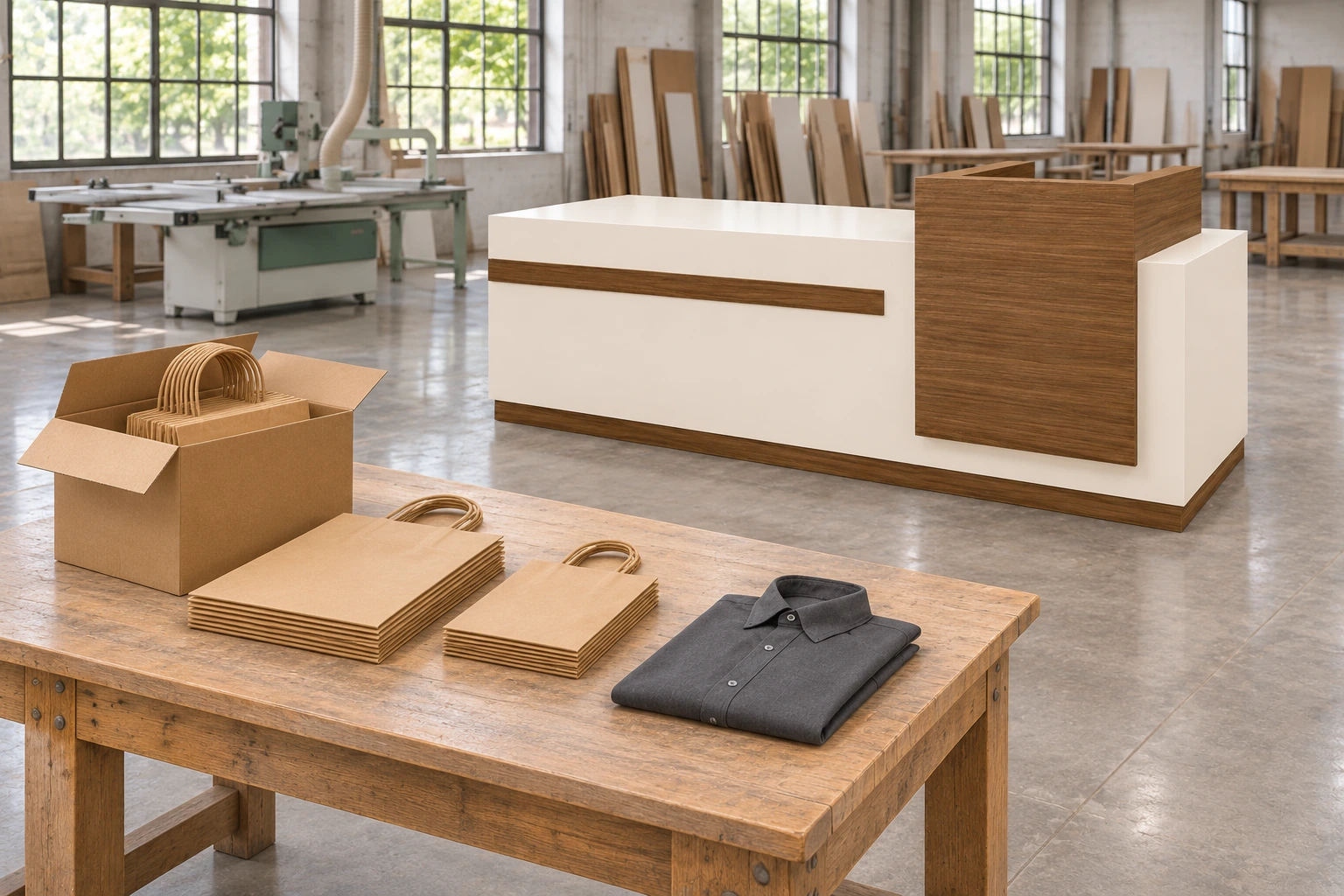
Assign one location to each approved bag size. Use a simple internal identifier on a removable divider or stock record, keeping it separate from customer-facing branding. Decide who checks the supply before a busy period and where unopened reserve packs belong. A reserve carton placed on the floor can undermine an otherwise tidy arrangement.
Choose the refill trigger from observed consumption and the store’s own replenishment routine. Avoid quoting a universal number of bags or hours. A small boutique with occasional purchases and a busy seasonal store need different working quantities. Record the chosen level in the operating note and revisit it after the layout has been used.
Keep damaged, damp, or incorrectly sized bags apart from usable stock. When changing packaging supplier, repeat the dispensing test before ordering a replacement holder. A familiar nominal size does not guarantee the same handle layout or stack behavior.
Include cleaning and changeover in the purchase brief
Ask how staff can remove loose paper, dust, and packaging fragments from the proposed holder. Confirm cleaning products with the accessory and furniture suppliers; do not assume a cabinet finish tolerates every spray or solvent. Keep spare bags away from cleaning liquids while the area is being serviced.
Check that removable parts can be returned to the same position and that fasteners remain accessible to authorized maintenance staff. Replenishment should not require routine dismantling of the cabinet. If an attachment needs tools for service, define who performs that work and how the station is taken out of use.
Coordinate the bag station with the store’s wider presentation, using the apparel display planning guide ve clothing presentation methods for the merchandising areas. Those pages address garment display; this checklist addresses the packing consumables at checkout.
A neutral video on workstation observation
UC Riverside’s ergonomic specialist explains general workstation setup and posture in the following educational video. The demonstration concerns home and computer work, not bag dispensers. Use it as background for noticing body position during the counter trial; it does not validate a retail accessory or replace task-specific assessment.
Watch the UC Riverside ergonomics video on YouTube.
What to send with a quotation request
Send physical bag samples, folded dimensions, intended working quantity, a counter plan, equipment locations, and photographs of the proposed staff side. Identify whether the request is for host cabinetry, a separate accessory, or both. Ask the supplier to state inclusions explicitly, including any mounting hardware, removable trays, and installation responsibility.
Request an approval drawing showing retrieval and refill access before manufacture. Include acceptance checks for full and nearly empty stacks, drawer clearance, cleaning access, and the garment packing area. Discuss the proposal through the clothing store fixture planning service, while keeping any claimed accessory performance subject to the actual sample trial.
Sıkça Sorulan Sorular
Can one holder dispense every clothing store bag size?
Do not assume so. Trial every bag format, including handles and a representative stack. Separate compartments or different holders may be needed when bags have different loading and withdrawal requirements.
Is an under-counter dispenser always the best option?
No. It may preserve worktop space but interfere with staff movement, drawers, or replenishment. Compare it with a removable tray or countertop arrangement using the complete packing sequence.
Does the illustrated Ouyee counter include a bag dispenser?
The reference imagery establishes the visible host counter only. A bag holder, fixing position, internal compartment, and accessory performance must be separately specified and confirmed.
How should a store decide when to refill bags?
Observe its own consumption and replenishment opportunities, then set a documented trigger for each bag size. Review that trigger during seasonal changes rather than adopting an unsupported universal quantity.
What should be checked before attaching a holder?
Confirm the supporting substrate, fixing method, usable opening, moving hardware, cable access, and cleaning route with the cabinet maker and accessory supplier. Approve the actual bag and counter trial before permanent installation.





 Turkish
 English
 German
 Arabic
 French
 Spanish
 Italian
 Russian
 Portuguese
 Japanese