Vintage rhinestone jewelry has a special charm. Each piece tells a story with its unique sparkle and design. But over time, dust, oils, and age can make these treasures look dull. Many owners fear cleaning them. They worry that cleaning will damage the delicate foil backing. They also worry it might loosen the stones or ruin the metal. This guide will show you how to clean rhinestone vintage jewelry safely. We’ll teach you the same methods that professionals use. We promise to give you a step-by-step method that protects your precious items. The golden rule is simple: never soak or submerge your vintage rhinestone jewelry in any liquid. Moisture gets trapped behind the stones. This destroys the foil backing, which is what creates their brilliant sparkle.

Key Takeaways
- Never Soak Your Jewelry: The most important rule is to avoid putting vintage rhinestone pieces in water or any cleaning solution. Moisture is the main cause of damage to the foil backing.
- Inspect Before You Clean: Always look at your jewelry first. Find out what type of rhinestones they are (foil-backed or open-backed). Also check their settings (prong, pasted, or bezel) to choose the safest cleaning method.
- Use Gentle, Dry Methods First: Start with a soft brush to remove loose dust and debris. This is often all that is needed. It is the safest approach for all types of vintage rhinestone jewelry.
- Clean with a Barely Damp Swab: For tougher grime, use a cotton swab that is only slightly damp with distilled water or a specific cleaner. Immediately dry each spot to prevent moisture damage.
- Know What You Can’t Fix: Darkened or “dead” stones have damaged foil backing. This cannot be repaired by cleaning. Understanding this prevents you from scrubbing and causing more harm.
Before You Clean: A Crucial 3-Step Inspection
Before you start, a careful check is the most important step in learning how to clean rhinestone vintage jewelry. This “triage” system helps you understand your specific piece. It lets you choose the right cleaning method. It also helps you avoid costly mistakes. Taking a few minutes to inspect your jewelry can save it from permanent damage.
Step 1: Identify Your Rhinestone Type
The type of rhinestone determines how much moisture it can handle. There are two main kinds in vintage jewelry.
-
Foil-Backed Stones (Closed Back): These are the most common. They have a metallic coating on the back of the glass stone. This foil reflects light, creating the sparkle. These stones are very sensitive to moisture. If water gets behind the stone, it will ruin the foil. This makes the stone look dark or “dead.”
-
Open-Backed Stones: On these pieces, you can see through the stone from the back. There is no foil. These are more durable. They can handle a slightly more thorough cleaning. However, you still need to be gentle.
Here is a simple way to tell them apart:
| Feature | Foil-Backed Rhinestones | Open-Backed Rhinestones |
|---|---|---|
| Back View | Solid metal setting covers the back of the stone. | You can see the back of the glass stone through the setting. |
| Moisture Risk | Very High. Moisture is trapped and damages the foil. | Lower. Moisture can evaporate more easily. |
| Commonly Found In | Most costume jewelry from the 1920s to today. | Higher-end costume pieces, often mimicking fine jewelry. |
Step 2: Assess the Stone Settings
How the stones are held in place also affects how you should clean your vintage jewelry.
-
Prong-Set: Tiny metal claws hold the stone. These prongs can be old and fragile. They might snag cleaning cloths or break if you are too rough. Dirt often collects around the base of the prongs.
-
Pasted/Glued-In: The rhinestones are glued directly into the setting. This is very common in older costume jewelry. The glue used is often water-soluble. Any liquid, including water and alcohol, can dissolve the glue. This causes stones to fall out. This is a major reason why you should never soak these pieces.
-
Bezel-Set: A metal rim completely surrounds the stone. This setting is usually very secure. However, grime can get trapped between the metal rim and the edge of the stone.
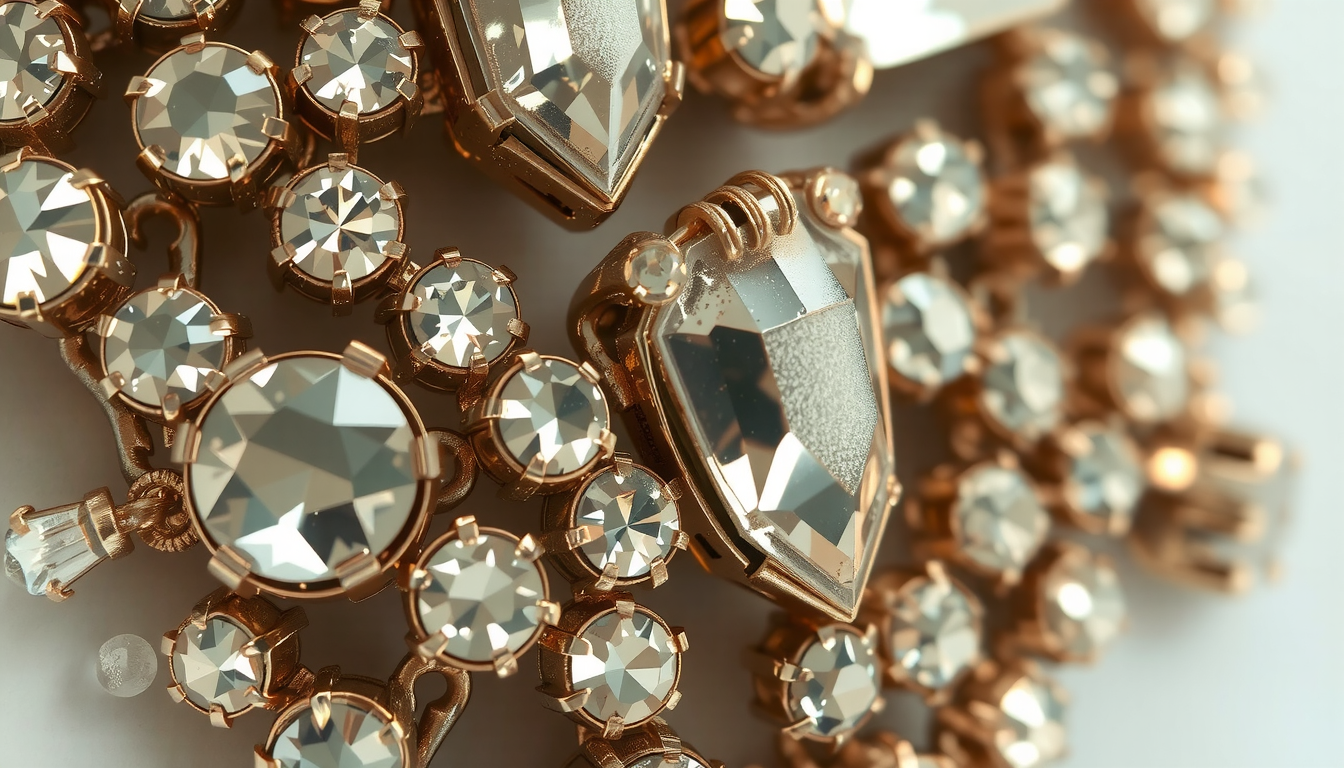
Step 3: Diagnose the Dirt and Damage
Look at your jewelry under a bright light. A magnifying glass can be very helpful. Knowing what kind of dirt you are dealing with will guide your cleaning process.
-
Light Dust & Debris: This is the easiest problem to solve. It usually looks like a fine layer of powder on the surface and between stones.
-
Oily Residue or Grime: This comes from skin oils, lotions, perfume, or hairspray. It makes the stones look cloudy and dull. It requires a more targeted cleaning approach than just dust.
-
Verdigris: This is the “green gunk” you might see on the metal parts of your jewelry. It is a greenish-blue powder that forms when copper or brass corrodes. Verdigris is corrosive itself. It can eat away at the metal plating if not removed carefully.
-
Darkened or “Dead” Stones: Look for stones that appear gray, black, or have no sparkle at all. This is almost always caused by moisture that has already damaged the foil backing. This damage is permanent. It cannot be fixed by cleaning. Knowing this helps you manage your expectations.
Gathering Your Gentle Cleaning Toolkit
To properly clean your vintage rhinestone jewelry, you need the right tools. Harsh tools or chemicals will cause damage. We recommend creating a small, dedicated kit.
Here is a list of what you will need:
* Soft-bristled brushes: A clean baby toothbrush, a soft makeup brush (like an eyeshadow brush), or a small artist’s paintbrush are perfect.
* Lint-free cloths: Microfiber cloths or a jeweler’s polishing cloth work best. Avoid paper towels, which can leave lint behind.
* Cotton swabs and wooden toothpicks: These are essential for precision work in tiny areas.
* A small bowl: To hold a small amount of water if needed.
* Distilled water: Use this instead of tap water. Tap water contains minerals that can leave white spots on your jewelry.
* Mild, ammonia-free foaming glass cleaner OR a tiny drop of pH-neutral soap: A gentle baby shampoo or a simple dish soap without extra chemicals is a good option.
* A dark-colored towel: Work on a dark towel. If a stone happens to fall out, it will be much easier to see and find.
How to Clean Vintage Rhinestone Jewelry: The Professional Method
Now that you have inspected your piece and gathered your tools, you are ready to clean. How do you clean vintage rhinestone jewelry without causing harm? You do it in careful stages. Start with the gentlest method and move to a more targeted one if needed.
Method 1: The Dry-Clean
This should always be your first step. For many pieces with just light dust, this may be all you need to do. It is the safest method for all vintage rhinestone jewelry. This is especially true for pieces with pasted-in, foil-backed stones.
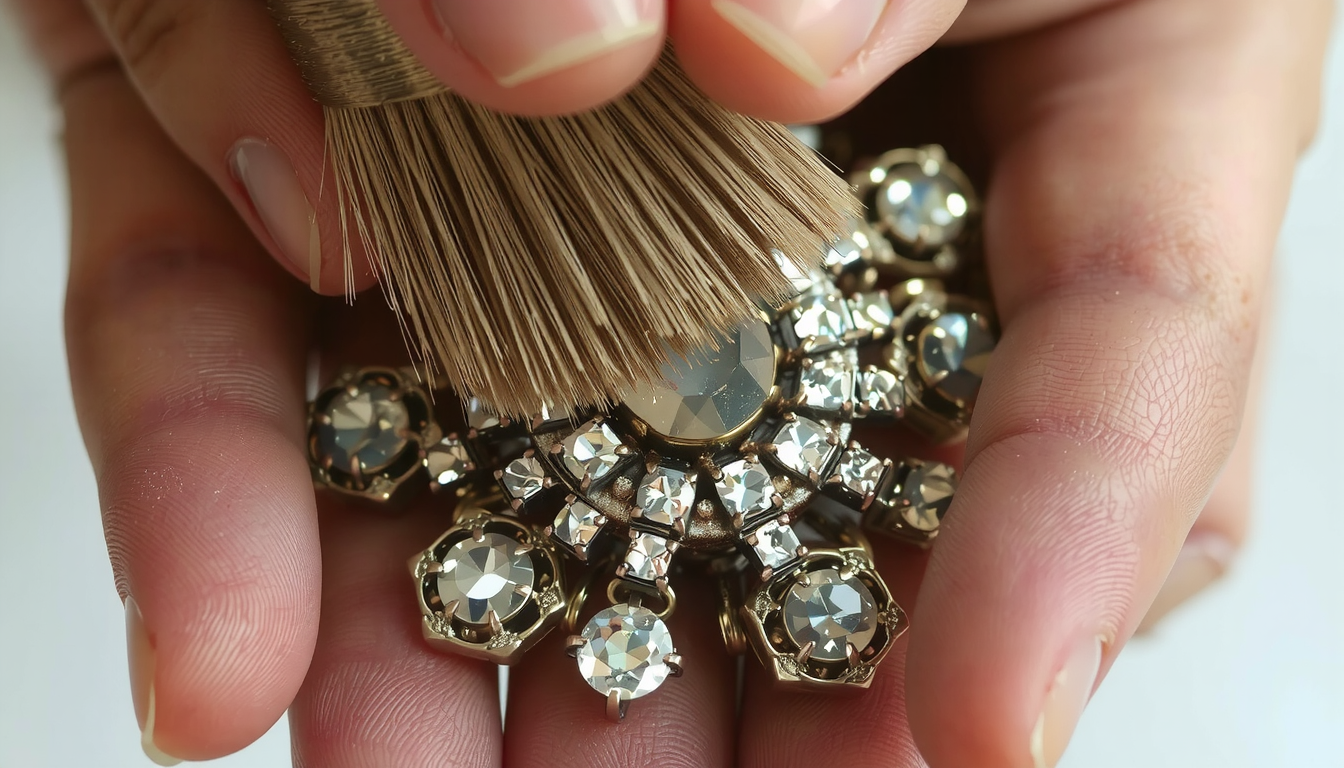
Use your soft brush with gentle, sweeping motions. Imagine you are an archaeologist dusting a delicate fossil. Pay special attention to the areas around the prongs and settings where dust loves to hide. Brush the tops of the stones and the metalwork.
After brushing, take your dry, lint-free cloth. Give the entire piece a gentle wipe. This will pick up any loosened dust. It will also add a bit of shine to the metal.
Method 2: The Targeted Damp-Clean
If your jewelry is still dull from grime or oils after a dry-clean, you can move to this next step. This method is for stubborn dirt. Remember, the goal is to be targeted. Use as little moisture as possible. This is not about getting the jewelry wet.
Here is a video showing a gentle cleaning technique:
Instructions:
1. Choose your cleaner. You can use either distilled water or a small amount of ammonia-free foaming glass cleaner. If using soap, mix one tiny drop into a small bowl with a few tablespoons of distilled water.
2. Lightly dampen a cotton swab or the very tip of your soft brush in your chosen liquid.
3. CRITICAL STEP: Blot the swab or brush on a dry part of your towel until it is barely damp. It should not be wet enough to leave a visible water droplet. This is the most important part of the process.
4. Gently and carefully clean the surface of each rhinestone, one by one. Focus only on the top of the stone. Try to avoid the metal settings and any seams where moisture could seep in.
5. Immediately after cleaning a stone or a small section, use a fresh, dry cotton swab to absorb any remaining moisture.
6. For open-backed pieces, you can carefully clean both the front and back of the stones. For foil-backed pieces, you must only clean the top surface.
This damp-cleaning technique is a trusted method. It brings back shine without risking the integrity of the piece. This is a principle shared by many jewelry care experts. Following A Step-By-Step Guide to Cleaning Rhinestone Jewelry like this ensures a safe and effective result.
Advanced Problem-Solving: Verdigris and Dead Stones
Sometimes, you will encounter issues that go beyond simple dirt. Knowing how to handle these problems separates a good cleaning from a disastrous one. This is a key part of understanding how to clean rhinestone vintage jewelry like an expert.
How to Safely Remove Verdigris
Verdigris, that green crust, is a sign of corrosion on copper-based metals. It can weaken the metal. It can also damage the plating if left alone. Removing it requires great care.
First, try to remove it dry. Use a wooden toothpick to gently flake off any loose, powdery verdigris. Be very careful not to scratch the metal plating underneath.
For more stubborn spots, you can use a bit of moisture. But you must use extreme caution. Dip the very tip of a toothpick in a tiny drop of distilled water or lemon juice. Apply this ONLY to the green spot. Do not let it touch the rhinestones or the glue. Let it sit for 30 to 60 seconds. Then gently try to lift the verdigris with the toothpick.
Immediately after, you must neutralize the area. Use a new cotton swab barely dampened with distilled water to wipe the spot. Then, use a dry swab to ensure the area is completely dry.
The Unfortunate Truth About Darkened (“Dead”) Rhinestones
If you see stones that are gray, black, or have lost all their sparkle, you are likely looking at foil damage. This is caused by moisture that has seeped behind the stone. It has corroded the metallic backing.
This foil is often a silver or gold-colored metallic paint. It could also be thin leaf applied since the 18th century to mimic diamonds. This is what gives the rhinestone its brilliance. Once it tarnishes or peels, the light can no longer reflect properly.
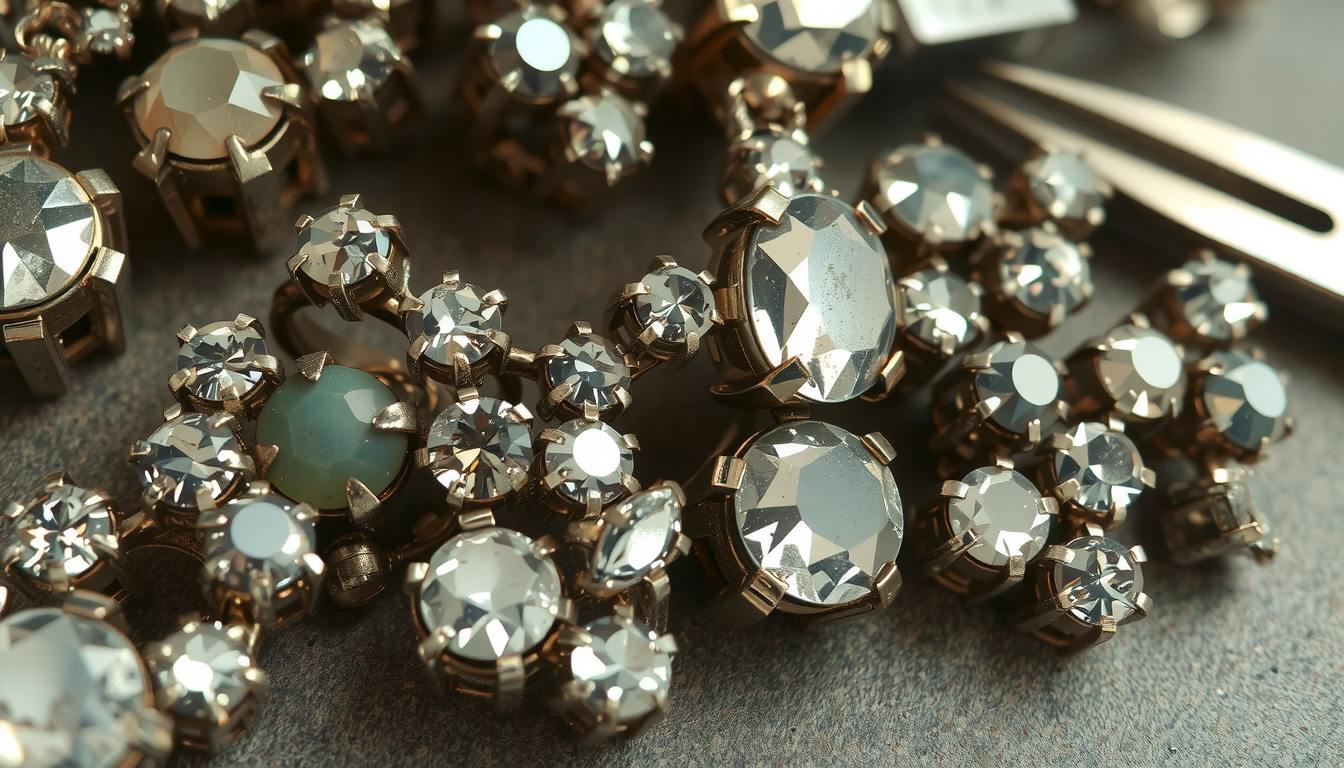
It is critical to understand that this damage cannot be repaired by cleaning. No amount of scrubbing will bring the sparkle back. In fact, trying to clean a dead stone aggressively can loosen it from its setting. The only real solution for a dead stone is to have it professionally replaced by a jewelry repair expert.
The Cardinal Sins: 7 Things You Must NEVER Do
When learning how to clean rhinestone vintage jewelry, what you don’t do is just as important as what you do. Avoiding these common mistakes will protect your collection.
- NEVER soak or submerge the jewelry. We cannot repeat this enough. It is the fastest way to destroy foil backings and dissolve old glue.
- NEVER use an ultrasonic cleaner. The vibrations are too strong. They will almost certainly shake pasted-in stones loose.
- NEVER use harsh chemicals. This includes ammonia, bleach, acetone, and abrasive polishes like silver polish. They can strip metal plating and cloud stones.
- NEVER use toothpaste. It is an abrasive. It will leave tiny scratches on the glass stones and metal. This permanently dulls the finish.
- NEVER use hot water or steam cleaners. Heat can weaken glues. It can also cause sudden temperature changes that may crack older glass stones.
- NEVER scrub aggressively. Always use a gentle touch. Too much pressure can break fragile prongs or dislodge stones.
- NEVER store it while even slightly damp. Trapped moisture is the enemy. Always ensure the piece is bone-dry before putting it away.
After the Sparkle: Proper Drying, Storage, and Display
Your work isn’t done after the cleaning. Proper care afterward ensures your vintage pieces stay beautiful for years to come.
The Art of Thorough Drying
After any damp cleaning, gently pat the piece with a dry, lint-free cloth. Then, lay it face up on a clean towel to air dry for several hours, or even overnight. This ensures any tiny bits of moisture deep in the settings can evaporate completely. For a quicker result, you can use a hairdryer on its lowest, coolest setting. Hold it at a safe distance.
Smart Storage to Preserve Your Collection
How you store your jewelry is crucial. Do not just toss it into a drawer.
Store each piece individually to prevent scratching. Soft cloth pouches work well. Boxes lined with acid-free tissue paper are also excellent choices. A jewelry box with separate compartments is another good option.
For extra protection in humid climates, consider adding a small silica gel packet to your jewelry box. These packets absorb moisture from the air. After a final check, proper storage is just as crucial as the cleaning itself. As experts in rhinestone care advise, thoughtful proper inspection and storage prevents future damage. It keeps your pieces ready to wear.
Displaying Your Treasures with Care
After you’ve learned how do you clean vintage rhinestone jewelry and restored its sparkle, you’ll want to show it off. A professional display company like Ouyee Display knows that the right presentation protects your items while showing their beauty.
For collectors, a custom jewelry showcase can keep your pieces safe from dust and curious hands. Working with an expert jewelry showcase manufacturer ensures that the lighting and materials used are safe for delicate vintage items. You can even apply principles from professional jewelry store design in your own home. This creates a beautiful and secure display for your most cherished pieces.
FAQ: Your Vintage Rhinestone Cleaning Questions Answered
Here are answers to some common questions we hear about how to clean rhinestone vintage jewelry.
Q1: Can I use Windex to clean my rhinestone jewelry?
A: We advise against it. While some people use ammonia-free glass cleaner with a very careful technique, many vintage glues and metal platings can be damaged by the chemicals in products like Windex. Our targeted damp-clean method using distilled water or a highly diluted, pH-neutral soap is a much safer alternative for your treasured pieces.
Q2: A rhinestone fell out while I was cleaning. What should I do?
A: Don’t panic. This often happens with older, pasted-in stones when the original glue fails. Carefully put the stone in a safe place. Use a toothpick to gently scrape the old, brittle glue out of the empty setting. Let the setting dry completely. Use a tiny dot of jeweler’s cement (G-S Hypo Cement is a popular choice) on the tip of a toothpick. Place it in the setting. Then carefully reseat the stone with tweezers.
Q3: How often should I clean my vintage rhinestone jewelry?
A: This depends on how often you wear it. For pieces you wear frequently, a quick dry-brushing after each use is a great habit to get into. A more detailed damp-clean should only be performed when the piece is visibly dirty or has lost its sparkle. For most pieces, this might be once a year at most. With vintage jewelry, less is more.
Q4: My silver-toned setting is tarnished. How do I clean it without hurting the rhinestones?
A: This requires a very delicate touch. Do not use liquid silver polishes. They will seep under the stones. Instead, use a silver polishing cloth. Carefully rub only the exposed metal areas. Stay away from the rhinestones and the edges of their settings. Work slowly and precisely to avoid damaging the stones or their foil backing.
Q5: Is it safe to buy vintage rhinestone jewelry that looks dirty?
A: Yes, it can be, as long as you inspect it carefully before buying. Use the three-step “triage” system from this guide. Check for dull, gray, or black stones. These signal irreversible foil damage that cleaning won’t fix. Surface grime and dust can be cleaned using our methods. Also, check for verdigris and make sure all the stones are present.
Conclusion
Learning how to clean rhinestone vintage jewelry is about being gentle, patient, and informed. By following the steps in this guide, you can confidently restore the brilliance of your pieces without fear of causing harm.
Always remember the core philosophy: inspect first, clean gently, and prioritize the safety of the jewelry. Your greatest enemy is moisture. Your best friends are a soft brush and a careful hand. With this knowledge, you can ensure your beautiful collection of vintage rhinestones continues to sparkle and tell its story for many more years.