
A removable divider on an apparel folding display table should separate garment groups without trapping fabric, obstructing hands, or leaving marks when the layout changes. Start with the folded garments, the actual tabletop edge, and a physical accessory sample. Then test the arrangement with full stacks, nearly empty stacks, and the divider removed. An accessory that looks tidy in a photograph may still slide, catch a sleeve, or make replenishment awkward.
This guide focuses on specifying and checking optional removable dividers for apparel folding display tables. It does not assume that a table includes dividers, that a shelf accessory fits a tabletop, or that a clear panel can support leaning customers. The objective is a reversible arrangement your team can change without damaging the furniture or its merchandise.
Define the separation task before choosing hardware
Decide what the divider needs to distinguish: sizes within one style, neighboring colors, separate collections, or a small clearance section. These are different tasks. If staff cannot explain the boundary simply, adding a physical panel may create another object to maintain without making the display easier to shop.
Build a trial with representative garments rather than identical empty packaging. Include the widest folded item, the bulkiest knit, and a soft piece that spreads when lifted. Leave realistic room for fingers beside each stack. Ask someone unfamiliar with the arrangement to remove an item and put it back. Record where their hand meets the panel, its foot, or the next stack.
For the larger furniture decision, use our clothing store fixtures buyer’s guide. The divider decision comes after the table’s role and position are established; it cannot correct an unsuitable aisle location or insufficient display area.
Use a verified host table, then specify the accessory separately
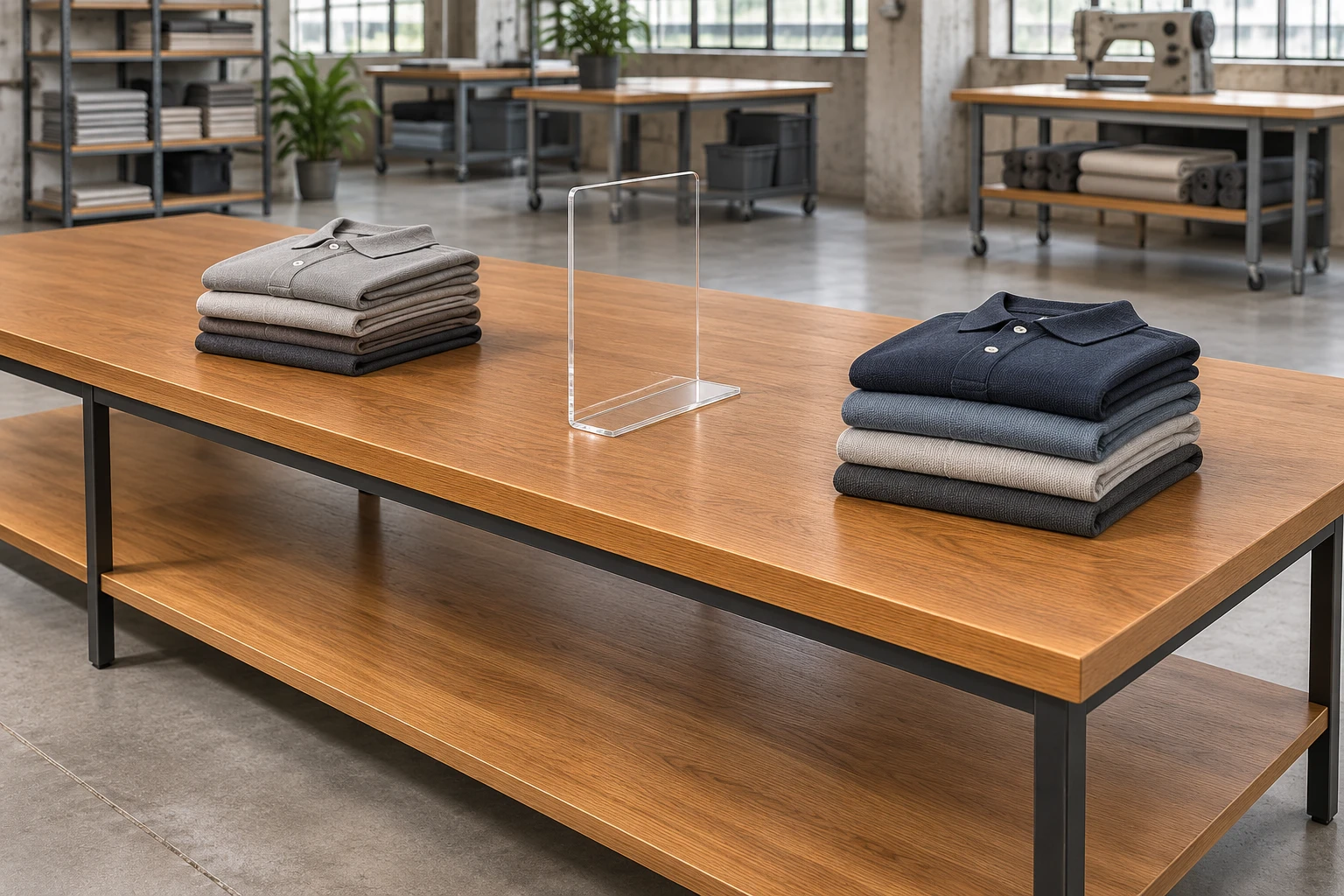
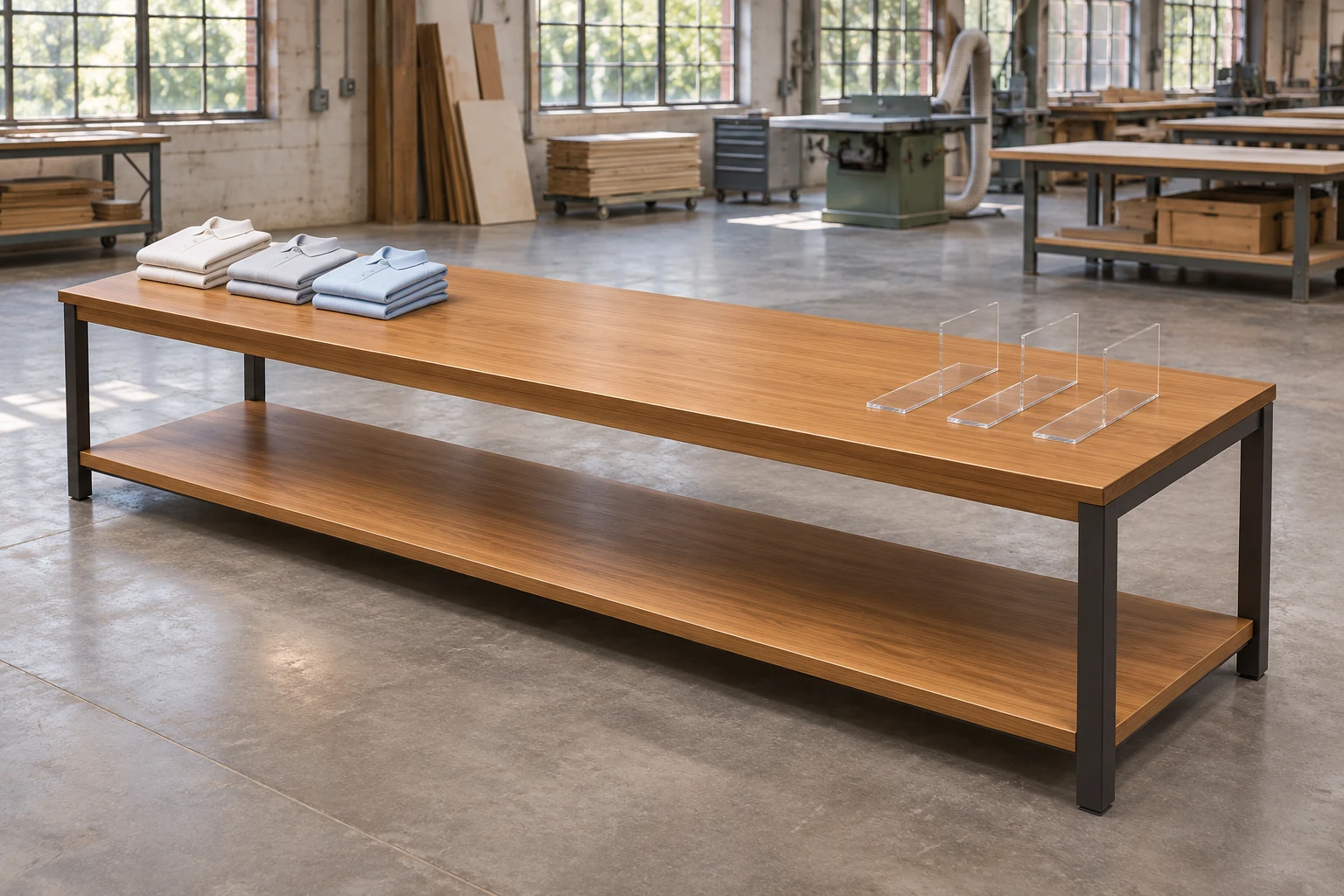
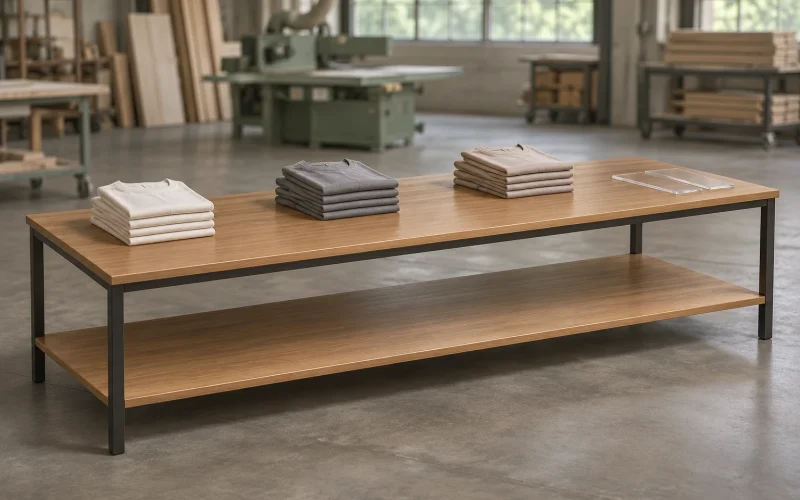
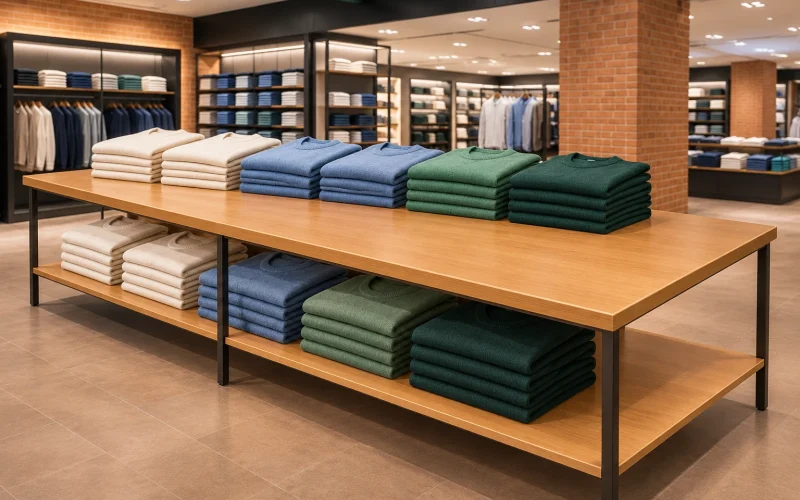
Этот Комплект стендов для одежды и костюмов, сложенных и выставленных на стене provides the reference for the illustrations here. Its published imagery shows a rectangular wood-tone presentation table, an open lower shelf, and dark supports. The product description includes folded-knit shelving and formalwear presentation tables.
That evidence establishes a relevant host fixture. It does not establish a supplied divider, a mounting channel, a particular coating, or a permitted clamping force. The loose clear panels shown in our illustrations are proposed accessory samples. Their dimensions, contact materials, and attachment method must be agreed separately with the furniture and accessory suppliers.
Ask for a current drawing or a physical sample of the actual table edge. A thick-looking edge may include an apron or a shaped profile underneath. An accessory that fits a flat shelf board might collide with those features. Do not infer hidden construction or drilling permission from a product photograph.
Measure the usable area and the complete contact path
Measure the clear tabletop width and depth, including any signs, display stands, or other objects that will stay in place. Measure the folded footprint of each garment group. Work with usable space rather than the table’s advertised overall size. A divider foot and its protective contact layer occupy space even when the upright panel appears almost invisible.
For an edge-fitting design, record the top thickness, edge shape, underside clearance, and distance to the nearest support. For a free-standing design, record the complete foot outline and where it will sit relative to garment edges. Neither design should require compressing garments to make a layout fit.
Set the panel back from customer-facing corners where practical and test the actual reaching movement. Check the lower shelf at the same time: a hanging clamp, screw knob, or projecting foot must not create a new obstacle for staff retrieving stock below. Ask suppliers to confirm the fit in writing rather than treating a similar-looking installation as proof.
Compare attachment approaches by their failure points
The following is a qualitative trial checklist, not a list of approved fittings for the reference table. It gives the buyer specific questions to resolve before ordering. The selected supplier’s instructions and a test on the agreed finish take precedence over a generic accessory description.
| Proposed approach | Fit evidence to collect | Trial that matters | Reason to reject or revise |
|---|---|---|---|
| Free-standing divider with a broad foot | Full foot footprint and permitted use with light stock | Remove garments until the adjacent bay is nearly empty | Panel tips, slides, or depends on an unreliable garment weight |
| Edge-fitting removable clip | Accepted edge profile, thickness range, and underside clearance | Fit and remove a sample using the maker’s instructions | Forced fit, pressure marks, or contact with the lower shelf |
| Divider on a separate removable tray | Tray dimensions, handling method, and table-contact material | Lift the cleared tray and check the contact surface | Tray is awkward to handle or retains debris beneath it |
| Adhesive-mounted panel | Written approval for the exact finish and removal process | Perform the agreed sample application and removal check | Residue, discoloration, finish lifting, or uncertain reversibility |
| No physical divider | Clear stack spacing and an understandable labeling plan | Shop and replenish the arrangement without panels | Groups remain confusing; revisit layout before adding hardware |
Do not add improvised screws or stronger adhesive to rescue a failed sample. A removable accessory should have a defined removal method. If that method is unclear, the proposal is not ready for the shop floor.
Test empty, full, and changing garment bays
First inspect the accessory on a cleared table. Check whether it sits as intended and whether its contact areas are visible enough to clean. Then arrange representative stacks and remove one garment at a time. Observe the panel when it loses the support of neighboring merchandise. A display must remain manageable as stock sells through.
Next, ask staff to replenish a nearly empty bay while another person browses beside it. Check whether lifting a folded item causes sleeves, tags, or loose fabric to pass under the divider foot. Reposition or reject an arrangement that requires pulling fabric against the panel. Include a complete change from lightweight shirts to bulkier garments in the trial.
Этот Canadian Conservation Institute’s textile care guidance explains the importance of supporting textiles and avoiding unnecessary handling and snagging. Its subject is historic material, so it supplies handling principles rather than a retail accessory specification. Use current garment care instructions for the merchandise itself.
A neighboring topic, checking knitwear contact with display shelf edges, addresses the furniture surface. Here the distinct decision is whether an optional divider can be fitted, used, changed, and removed successfully.
Plan cleaning and the seasonal reset
Write the reset sequence before placing an order: clear the garments, remove the accessory as instructed, inspect its contact points, clean approved surfaces, and store the parts. Check that every step is possible without moving the whole table or reaching awkwardly beneath it. Staff should not have to balance loose panels among sale stock.
Obtain separate cleaning guidance for the panel, its pads or clips, and the tabletop finish. A treatment suitable for one material may not be approved for another. Do not assume that the accessory’s transparent appearance identifies its polymer or its chemical compatibility. Keep trial records tied to the supplied material and finish.
National Museums Scotland’s object-handling guidance emphasizes planning movements and providing appropriate support. Applied cautiously to this retail task, that means preparing a clear destination for garments and loose parts before dismantling the arrangement. It is not evidence that a proposed accessory is museum-grade or suitable for a particular fabric.
Use neutral textile guidance to brief the team
The Indiana Historical Society’s short educational video discusses handling and storing textiles in museum collections. It offers useful context for deliberate handling while a display is cleared. Retail garments have different use conditions; the video neither approves divider materials nor demonstrates the reference table.
Further learning: Timely Tips: Handling and Storing Textiles, Indiana Historical Society.
Send a decision-ready inquiry and retain the accepted sample
Send the supplier photographs of the actual table edge and underside, measured usable space, folded garment samples, and the intended separation task. Include full and low-stock photographs from the trial. Request the proposed attachment method, material identification, cleaning instructions, replacement-part details, and confirmation of who approves contact with the finish.
Keep the accepted sample and a short illustrated setup sheet. Record what changed after testing, which garment groups were used, and which conditions remain untested. Recheck when the table finish, accessory supplier, or merchandise changes. A successful trial with cotton shirts does not automatically cover delicate knits or substantially larger stacks.
For broader layout coordination, see our clothing store display planning ideas. For a complete project brief, review our clothing store fixture planning service. Bring the table position and accessory brief into the same review so the fixture, stock, and customer access are considered together.
Часто задаваемые вопросы
Does the illustrated apparel table include removable dividers?
No supplied divider is verified for the reference product. The panels in these illustrations are proposed accessory samples. Confirm the actual accessory, attachment method, and finish compatibility separately before ordering.
Can a shelf divider be clipped onto any folding table?
No. Check the actual edge thickness and shape, underside clearance, nearby supports, and the accessory maker’s accepted fit. A shelf-board compatibility claim does not establish compatibility with a table apron or shaped edge.
Should folded garments hold a divider in place?
Do not assume that they will. Follow the accessory’s instructions and test the arrangement with nearly empty bays. Reject a proposal that becomes unstable during normal stock depletion or removal of a neighboring stack.
How should a removable divider be checked for seasonal changes?
Trial the replacement garments, remove the accessory using the specified method, and inspect the contact surface. Confirm that cleaning and storage are practical and that the next arrangement does not require forced fitting or unapproved adhesive.
What should the buyer send with an inquiry?
Send table-edge and underside photographs, measured usable dimensions, representative folded garments, the intended grouping, and trial observations. Ask for written fit, contact-material, cleaning, removal, and replacement-part information.





 Russian
 English
 German
 Arabic
 French
 Spanish
 Italian
 Turkish
 Portuguese
 Japanese