
Coffee shop equipment delivery and installation planning should connect each delivery to a verified site condition, rather than put every supplier on the same opening-week calendar. Confirm the selected equipment and approved counter drawings, prepare the building services, position the counter modules in the agreed sequence, and release equipment delivery only when its support and access are ready. Leave removable closures open until the responsible contractors finish the checks that require access. The exact order depends on the counter construction, appliances, and installation instructions. This guide explains how a café owner can coordinate those dependencies; it does not provide electrical, plumbing, structural, or lifting instructions.
Start with a dependency list, not a delivery date
A counter supplier, equipment dealer, shopfitter, electrician, plumber, and building manager can each be ready on a different day. A delivery booking alone says little about whether the next task can proceed. Name one project coordinator who collects their requirements and records which condition releases each activity.
For example, the espresso technician may need an approved work surface and accessible connections. The shopfitter may need an appliance in position before fitting a removable surround. The counter maker may need the final appliance model before confirming an opening. Put those relationships into the schedule before fixing attendance dates. An unresolved model choice is a design dependency, even if the proposed delivery slot is available.
Usa il nostro coffee counter buying guide for comparing furniture formats. Once a format is chosen, the task here is different: coordinating the approved furniture, actual equipment, and responsible people through delivery and handover.
Freeze the equipment information that affects the furniture
Create an equipment register using the selected manufacturer’s current installation documents. Identify the model, overall envelope, support requirements, connection positions, ventilation needs, service clearances, and removal direction. Include undercounter refrigerators, filters, pumps, grinders, and waste equipment as applicable. A catalogue photograph or a nominal width is insufficient for approving the interface.
Ask the counter supplier and relevant equipment installer to review the same drawing revision. Mark any condition that still needs a site measurement or specialist approval. When a model changes, identify the affected openings, support, access, and services before accepting the substitution. Do not assume that a similar-looking machine can use the previous arrangement.
For a custom coffee counter project, provide this register alongside the layout. Keep a dated list of approved documents so a later delivery does not arrive against an obsolete drawing.
Assign each interface to a named person
Describe responsibilities as specific actions. “Installation included” can mean placing furniture, connecting an appliance, commissioning it, or several different things. Ask who prepares approved worktop openings, who verifies support, who supplies connection components, who completes building services, and who authorizes the equipment to operate.
La UK Health and Safety Executive’s equipment installation guidance emphasizes following the manufacturer’s installation instructions and specifications. Its legal discussion concerns the UK; the useful coordination point for other locations is to establish the applicable instructions and competent installers before work begins. Local requirements and the actual contract govern your project.
Record exclusions as well as inclusions. If the equipment technician does not modify joinery, the approved openings must be ready before that visit. If a counter supplier does not connect building services, appoint the appropriate local contractor rather than leaving the job between suppliers.
Separate site readiness from delivery readiness
Site readiness means that the area can receive the next activity safely and without obstructing other work. Check access authorization, agreed loading arrangements, the receiving area, and the installation zone. Confirm that dust-producing work, wet finishes, and other incompatible activities have been resolved for the planned stage.
Delivery readiness is item-specific. A freestanding counter module may be ready to arrive while a machine that needs completed connections is not ready for installation. Equally, an appliance may need to be available for a supervised fit check before an enclosing panel is completed. Ask the installers to define these exceptions in writing rather than impose one universal furniture-first sequence.
I nostri fixture site-survey checklist explains how to record installation conditions. Use the approved survey as an input to this schedule, without treating a recorded floor condition as an engineering approval.
Agree the counter-module placement sequence
Have the counter installer identify the actual module boundaries and placement order. A visible panel joint in a rendering does not prove a transport split. Ask which components must be positioned before adjacent furniture closes the working area, and which temporary openings must remain available for equipment or contractors.
Confirm how worktops, backwalls, display units, and any overhead elements relate to the sequence. The installer should explain which items can be placed independently and which require preceding support or assembly. Do not infer a connection method or a safe lifting point from the furniture’s appearance.
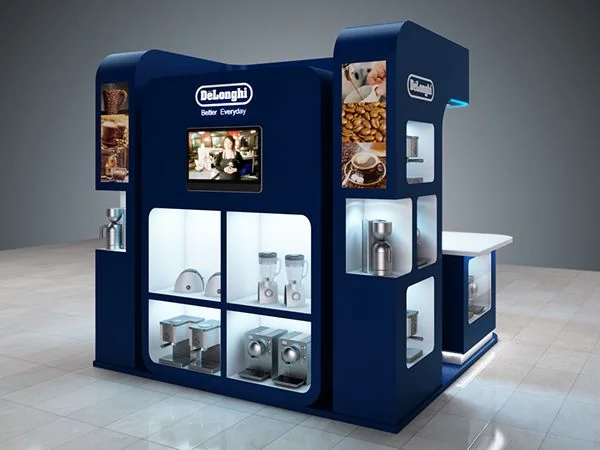
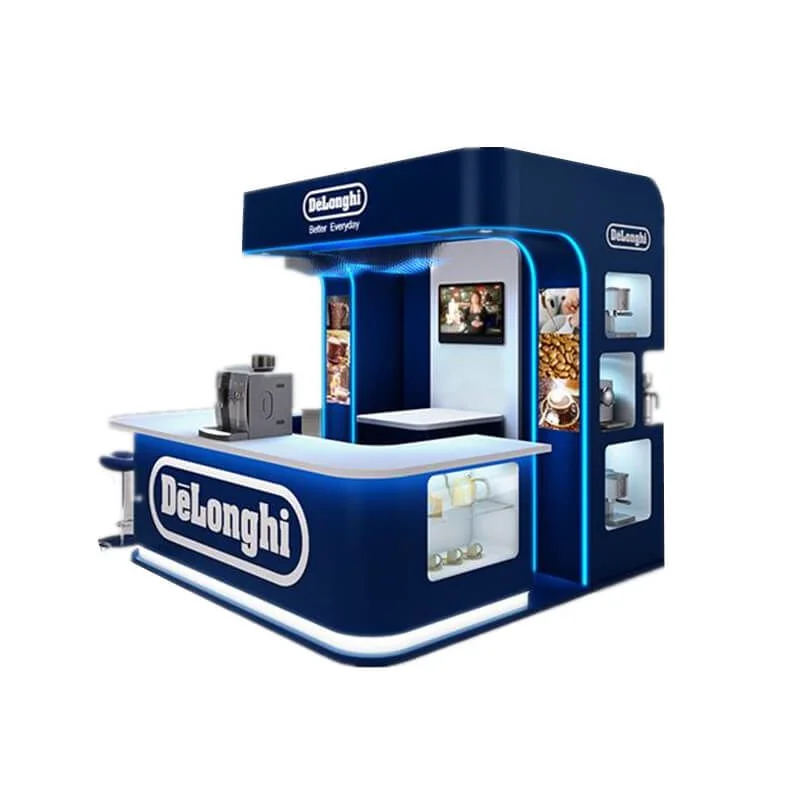
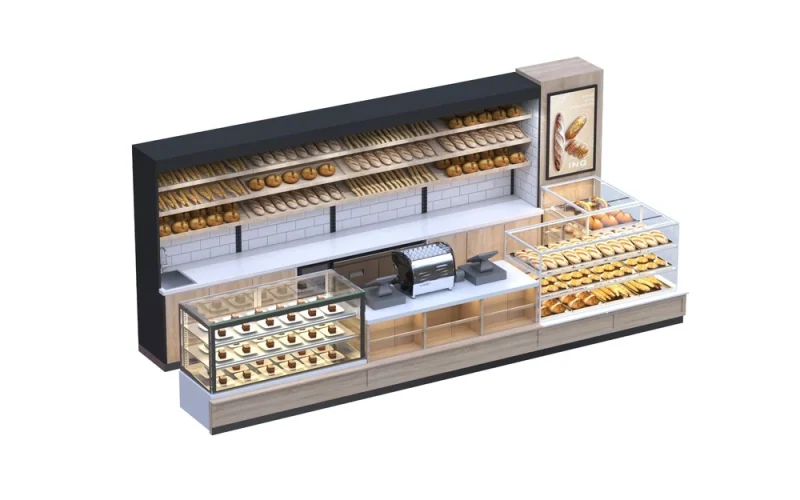
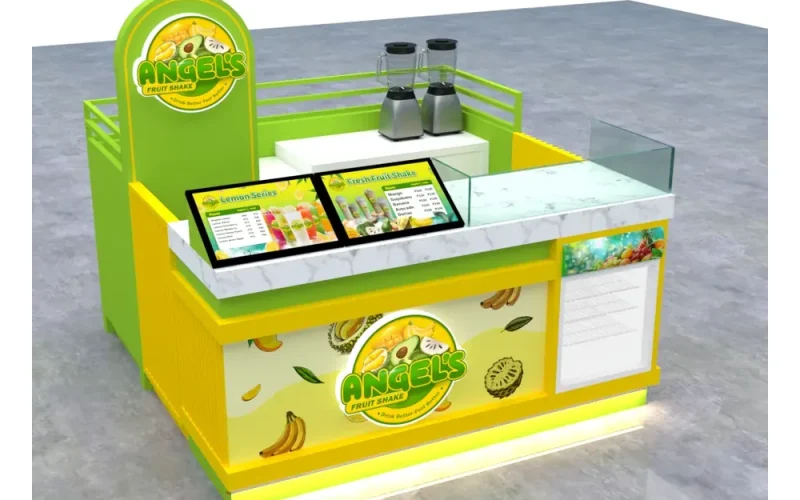
Questo blue coffee display kiosk illustrates why a customer-facing view is only part of the discussion. Request the actual assembly drawings for the order. Its displayed branding and appliances are visual references, not evidence of a brand relationship, equipment package, or approved café installation.
Use release checks between delivery stages
The following qualitative table is a planning record. It contains no universal installation dimensions, tolerances, or utility specifications. Complete it with the responsible suppliers and contractors, using the selected equipment and approved site documents.
| Next activity | Evidence needed before release | Who confirms it |
|---|---|---|
| Counter production | Approved equipment register, interfaces, and drawing revision | Owner, counter supplier, and equipment reviewer |
| Counter delivery | Agreed receiving arrangements and a ready installation zone | Site coordinator and counter installer |
| Module placement | Confirmed module order, support, and required temporary access | Counter installer |
| Equipment delivery or fit check | Suitable support, placement plan, and item-specific access | Equipment installer with the shopfitter |
| Service connections | Correct prepared services and the applicable installation instructions | Responsible qualified contractors |
| Closure and handover | Required checks complete, access retained, unresolved items assigned | Coordinator and relevant installers |
Give each release an owner, date, and document reference. A photograph may show that a connection point exists, but the responsible contractor must confirm whether it is suitable. If evidence is missing, hold the dependent activity and agree the revised arrangement before dispatch.
Plan equipment placement without inventing a handling method
Ask the equipment supplier to state the delivery format and what the delivery service includes. Establish whether the item arrives packaged, who takes custody, and who is responsible for final positioning. Receiving an appliance at the door is different from placing it on an approved counter and commissioning it.
La HSE’s manual handling guidance explains avoiding hazardous manual handling where practicable, assessing unavoidable tasks, and reducing risk. Have competent people assess the actual appliance, route, support, and equipment. A general article cannot prescribe a team size, carrying method, or lifting capacity for an unverified machine.
Schedule handling work so other trades and customers are kept clear of the agreed area. If an earlier furniture placement blocks the planned equipment movement, stop and have the installers revise the sequence. Do not solve a scheduling error with improvised lifting or an unauthorized change to the counter.
Keep connection and service access open until approved
Before closing a removable panel or finishing an adjacent unit, ask which checks require access behind or beneath the equipment. The responsible trades should confirm connection completion, any applicable tests, and whether the final arrangement permits the manufacturer’s required access.
Consider later filter replacement, maintenance, and appliance removal while the installation remains accessible. The aim is to agree a documented access arrangement, not to leave every panel open indefinitely. If closing the furniture traps a service item, refer the issue to the designer and installers before acceptance.
Prepare a fallback for a late or unsuitable item
Ask what can safely continue if one delivery or approval is late. A coordinator might reschedule an independent shelving delivery while holding the machine installation. Any temporary storage must follow the supplier’s requirements and the site’s arrangements; it should not obstruct the work zone or become an unplanned substitute installation area.
Record a change as a short decision: the missing condition, affected activity, responsible person, revised action, and next review time. Notify the people whose attendance depends on that condition. Avoid repeatedly booking technicians against an assumed completion date without confirmation from the preceding contractor.
Keep this schedule separate from the receiving and unpacking record. That record documents delivery condition; this one explains which installation activity may proceed next.
Close the sequence with a usable handover
Collect the final drawing revision, equipment identification, installation and operating instructions, relevant contractor records, and the outstanding-item list. Confirm that staff know whom to contact for the counter, appliance, and building services. Identify any restriction that prevents an item from entering service.
Record completion by scope. Furniture placement does not establish that equipment has been commissioned, and a functioning machine does not close an unresolved furniture-access issue. Arrange the required project acceptance and local approvals before opening the affected operation. Keep the final documents available for maintenance and future equipment replacement.
Further learning: reducing lifting risk
WorkSafeBC’s educational film, Lifting in the Workplace, explains lifting risk and ways to reduce it. Use it to support the planning conversation before equipment arrives. It does not approve a handling technique for your counter or machine. The WorkSafeBC resource page identifies the film and its purpose.
Watch Lifting in the Workplace on YouTube se il lettore incorporato non è disponibile.
Domande frequenti
Il banco caffè deve sempre arrivare prima delle attrezzature?
Non esiste un ordine universale. Occorre verificare la struttura del bancone, i requisiti degli elettrodomestici e il metodo di installazione. Alcune attrezzature richiedono che il supporto sia già completato prima della consegna; per altri elementi può essere necessario effettuare prima una verifica di montaggio sotto supervisione, prima di chiudere i mobili circostanti.
Cosa bisogna verificare prima di prenotare un tecnico per macchine da caffè espresso?
Chiedete al tecnico quali sono i requisiti di preparazione necessari per il modello selezionato. Verificate che siano disponibili supporti adeguati, servizi predisposti e accessi idonei, nonché l'ambito dell'installazione concordato con gli appaltatori responsabili. La sola data di consegna o una fotografia non costituiscono un'approvazione della preparazione.
È possibile sostituire il modello approvato con una macchina simile senza effettuare una nuova revisione?
Esaminare la sostituzione prima di accettarla. Le dimensioni complessive, i collegamenti, i supporti, la ventilazione, le esigenze di manutenzione e i requisiti di rimozione possono essere diversi. Aggiornare i disegni interessati e ottenere le relative approvazioni dal fornitore e dall'installatore.
Who should approve closing the counter’s access panels?
Il coordinatore dovrebbe ottenere la conferma dagli installatori le cui verifiche richiedono l'accesso a tali pannelli. Chiudere i pannelli esclusivamente in conformità al progetto approvato, solo dopo aver completato gli interventi necessari e aver garantito la disponibilità dell'accesso per gli interventi di assistenza concordati.
La consegna dei mobili significa che il bar è pronto per aprire?
No. Monitorare separatamente il posizionamento degli arredi, l'installazione delle apparecchiature, la messa in servizio, il passaggio di consegne al personale e le approvazioni di progetto applicabili. Gli elementi irrisolti devono avere un responsabile nominato e, ove necessario, una chiara limitazione d'uso.








 Italian
 English
 German
 Arabic
 French
 Spanish
 Russian
 Turkish
 Portuguese
 Japanese